
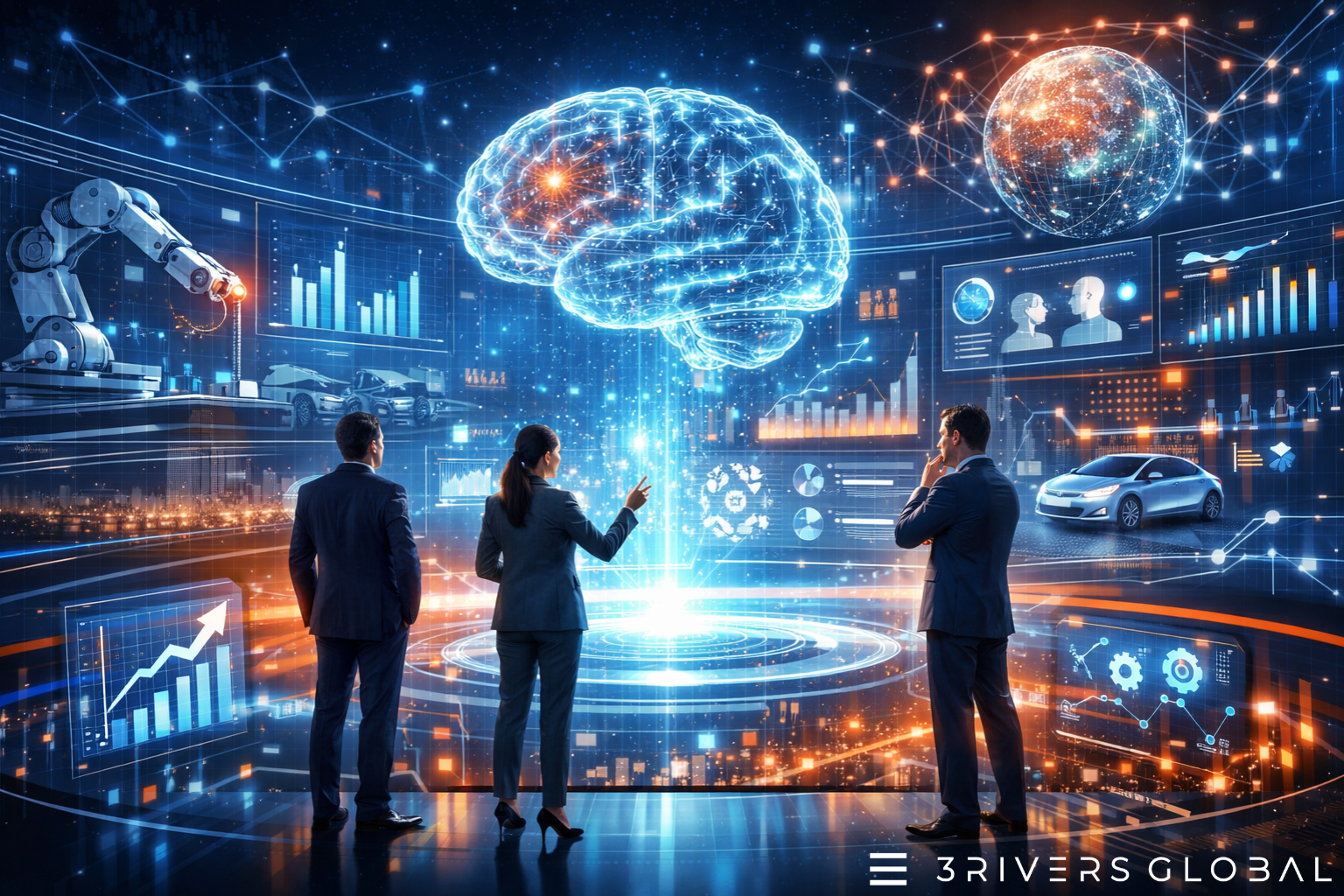
Artificial Intelligence (AI) has moved beyond the hype cycle. For enterprises across industries, the real question is no longer whether AI should be adopted, but how AI can deliver measurable growth and strategic advantage.
Many organizations are experimenting with AI pilots, generative AI tools, and automation platforms. Yet only a small percentage have successfully translated these initiatives into new revenue streams, scalable business models, and market leadership.
The difference lies in strategy.
Forward-looking enterprises are no longer treating AI as a technology experiment. Instead, they are embedding AI into core business strategy, product innovation, and operational decision-making — turning intelligence into growth.
This is where an AI Strategy for Enterprise Growth becomes critical.
From AI Experiments to Revenue Engines
The first wave of AI adoption focused largely on efficiency gains — automating tasks, reducing costs, and improving productivity.
While these benefits remain important, the most successful enterprises are now pursuing a second wave of AI transformation focused on revenue generation and market expansion.
Organizations leading in AI strategy are asking questions such as:
- Where can AI create entirely new product categories?
- How can AI enhance existing services to command premium pricing?
- How can data intelligence unlock new monetization opportunities?
In other words, AI is shifting from a cost optimization tool to a growth engine.
How Forward-Looking Enterprises Are Using AI
Enterprises that are capturing value from AI tend to focus on three strategic areas.
1. Unlocking New Revenue Streams
AI is enabling companies to build offerings that were previously impossible.
Examples include:
- AI-powered advisory platforms that deliver personalized recommendations at scale
- Predictive services that help customers anticipate risks and opportunities
- Data-driven subscription models built on proprietary enterprise data
In sectors ranging from financial services and healthcare to manufacturing and telecommunications, AI is transforming traditional products into intelligent platforms.
Enterprises that successfully leverage AI in this way shift their value proposition from selling products to delivering continuous intelligence.
2. Embedding AI into Business Decision-Making
The true power of AI lies in its ability to augment strategic decisions, not just automate workflows.
Forward-looking organizations are integrating AI into decisions such as:
- Pricing strategy
- Customer acquisition and retention
- Supply chain optimization
- Product development priorities
- Investment allocation
Instead of relying solely on historical reports, leaders now use AI-driven insights and predictive models to guide decisions in real time.
This enables enterprises to:
- Respond faster to market shifts
- Identify emerging opportunities earlier
- Allocate resources more effectively
Ultimately, AI becomes a decision intelligence layer across the enterprise.
3. Future-Proofing Product and Service Portfolios
Many organizations face a common risk: their current products may become obsolete in an AI-driven economy.
Forward-thinking enterprises are proactively redesigning their offerings to ensure they remain competitive in the years ahead.
This includes:
- Embedding AI capabilities directly into products and services
- Developing AI-enhanced customer experiences
- Launching data-enabled service layers around traditional offerings
For example:
A manufacturing company may evolve from selling equipment to offering AI-powered predictive maintenance services.
A software company may transform a traditional application into an AI-enabled decision platform.
These innovations help enterprises remain relevant while creating new long-term revenue streams.
The Strategic Challenges Enterprises Must Solve
Despite the potential, many AI initiatives fail to deliver value because organizations underestimate the strategic transformation required.
Common challenges include:
- Fragmented AI initiatives across departments
- Poor data infrastructure and governance
- Lack of clear monetization strategies
- Talent gaps in AI and data science
- Difficulty scaling pilot projects into enterprise-wide capabilities
Without a clear roadmap, AI investments can quickly become expensive experiments instead of strategic assets.
The Role of Digital Business Transformation
To fully capture the value of AI, enterprises must align technology innovation with business strategy, operating models, and revenue architecture.
This requires a broader digital transformation approach.
Successful organizations focus on:
- Aligning AI initiatives with core business objectives
- Building data ecosystems and platforms
- Creating AI-enabled operating models
- Designing AI-native products and services
- Developing AI governance and responsible use frameworks
In short, AI must be integrated across the enterprise — not treated as a standalone technology initiative.
How 3Rivers Global Helps Enterprises Unlock AI-Driven Growth
At 3Rivers Global, we work with enterprise leaders to transform AI from an experimental capability into a strategic growth engine.
Our approach focuses on helping organizations:
Identify where AI can generate real revenue impact
rather than simply optimizing internal processes.
Design AI-enabled product and service portfolios
that create new market opportunities.
Integrate AI into enterprise decision-making
to improve agility and strategic clarity.
Build scalable digital transformation roadmaps
that align technology innovation with business outcomes.
Through our Digital Business Transformation frameworks, executive programs, and advisory services, we help leaders dive into the transformative trends shaping the future of enterprise innovation.
Our goal is simple:
to help organizations stay ahead of the energy curve, navigate disruption, and unlock extraordinary growth.
Whether leaders are responsible for technology strategy, product innovation, customer experience, or revenue transformation, AI will play a defining role in the next era of enterprise competition.
Leading the Intelligent Enterprise Era
The next generation of industry leaders will not simply use AI.
They will build organizations designed around intelligence.
These enterprises will:
- Continuously learn from data
- Adapt rapidly to market shifts
- Launch new digital offerings faster than competitors
- Deliver increasingly personalized customer experiences
The opportunity is enormous — but capturing it requires clarity of strategy, disciplined execution, and bold leadership.
AI is not just a technological shift.
It is the foundation of the next generation of enterprise growth.
Leave a Reply
You must be logged in to post a comment.