
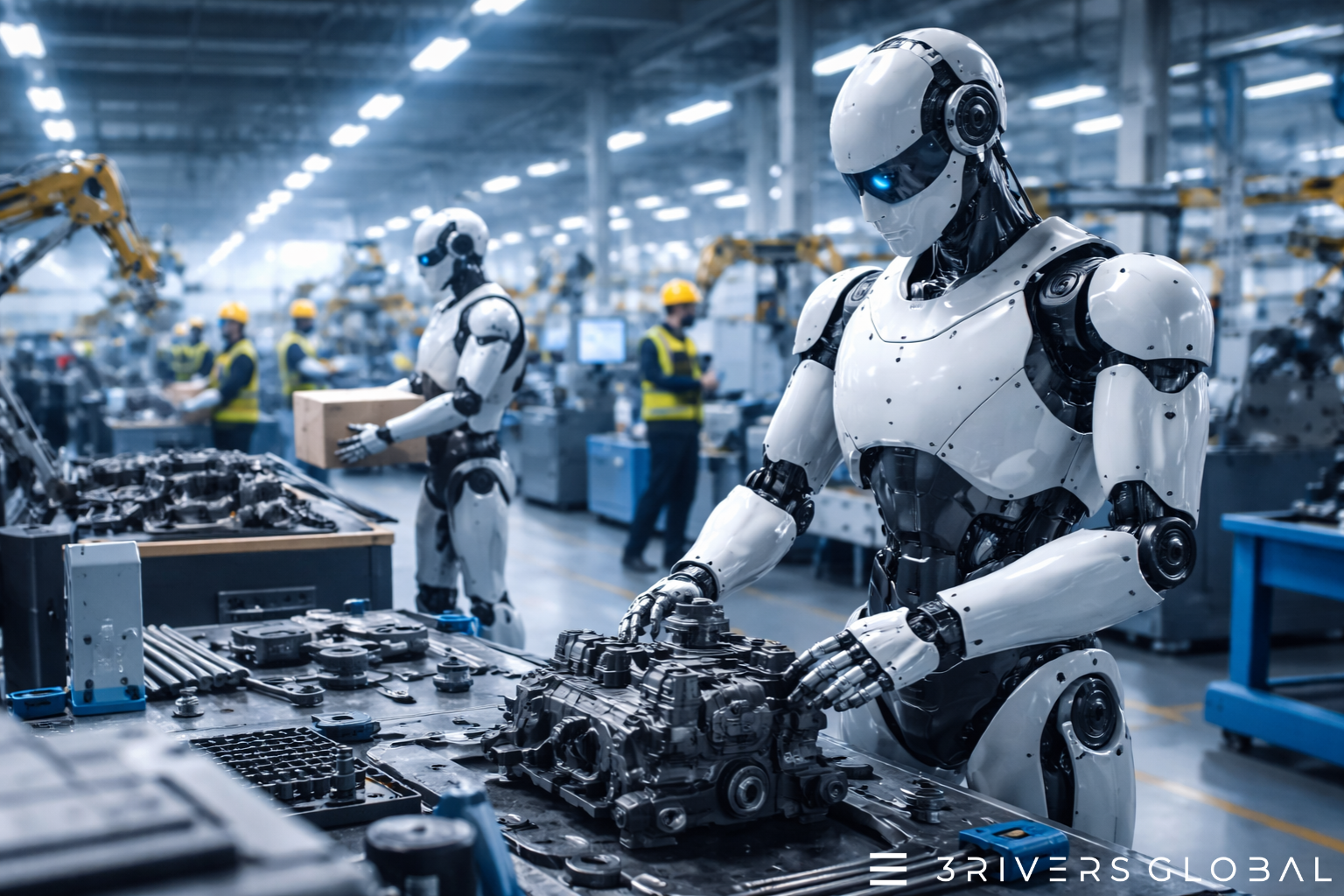
For decades, humanoid robots have lived in demos, research labs, and science fiction. That era is ending. Over the next few years, humanoid robots will become a real fixture on factory floors, warehouses, and industrial environments, not as novelty machines — but as flexible, AI-driven workers designed to operate in spaces built for humans.
Unlike traditional industrial robots, humanoids don’t require factories to be redesigned around cages, rails, or fixed workflows. They can walk, grasp, perceive, and learn in human-centric environments — making them uniquely suited to fill labor gaps, improve productivity, and handle increasingly complex tasks.
What’s changed isn’t just hardware. It’s the convergence of AI, simulation, perception, edge computing, and robotics software that’s accelerating humanoids from promise to production.
Why Humanoid Robots Make Economic Sense Now
Several forces are aligning at once:
- Labor shortages and aging workforces across manufacturing, logistics, and heavy industry
- Rising cost of downtime, errors, and rework
- Demand for flexible automation that can adapt without retooling entire production lines
- Advances in AI models that allow robots to learn tasks rather than be hard-coded
Humanoid robots excel where fixed automation struggles: unstructured environments, variable tasks, and human collaboration. Instead of replacing existing robots, they complement them — acting as a general-purpose automation layer on top of modern factories.
The Humanoid Robot Ecosystem Is Taking Shape
Hardware Leaders: Building the Physical Platform
Some of the most closely watched players are pushing humanoid hardware toward real-world deployment:
- Tesla is leveraging its deep expertise in AI, vision systems, batteries, and manufacturing scale to build humanoids designed for repetitive industrial tasks. Its approach treats robots as AI-first platforms rather than standalone machines.
- Agibot is part of a new wave of humanoid-focused companies emphasizing dexterity, balance, and real-time learning for industrial and service environments.
- NEURA is advancing cognitive robotics with a focus on safe human-robot collaboration, perception, and adaptive behavior — critical capabilities for shared factory spaces.
These platforms are increasingly modular, sensor-rich, and designed to improve over time through software updates rather than hardware replacements.
Software Is the Real Differentiator
Humanoid robots don’t scale because of motors and metal — they scale because of software.
Key software layers shaping the market include:
- Perception & vision systems for object recognition, depth sensing, and spatial awareness
- AI foundation models trained on physical tasks, enabling robots to generalize across environments
- Simulation and digital twins to train robots virtually before deployment
- Motion planning and control software that balances precision, safety, and adaptability
- Edge and cloud orchestration to manage fleets of robots in real time
As with cloud and AI, we’re seeing a separation between hardware platforms and software intelligence, opening the door for faster innovation and cross-vendor ecosystems.
Integrators: Turning Robots Into Business Outcomes
Most organizations won’t buy humanoid robots “off the shelf” and deploy them overnight. This is where systems integrators and transformation partners play a critical role.
Integrators help organizations:
- Identify where humanoids create ROI (not just where they look impressive)
- Redesign workflows to blend humans, robots, and AI
- Integrate humanoids with MES, ERP, WMS, and IoT platforms
- Manage change, safety, and workforce adoption
- Scale pilots into repeatable, enterprise-grade deployments
Without this layer, humanoid initiatives risk stalling at proof-of-concept.
How 3Rivers Global Helps Organizations Get Ahead
At 3Rivers Global, we see humanoid robots as part of a broader shift toward AI-driven, software-defined operations.
We help organizations move beyond hype by:
- Assessing readiness across technology, processes, and workforce
- Identifying high-impact use cases where humanoids complement existing automation
- Designing AI-first operating models that scale across sites
- Aligning robotics initiatives with digital transformation, cloud, and data strategies
- Supporting leaders through vendor selection, integration strategy, and governance
Our focus isn’t robots for robots’ sake — it’s enabling measurable productivity gains, resilience, and long-term growth.
The Bottom Line
Humanoid robots are no longer a distant vision. Within a few years, they will be as familiar on factory floors as industrial arms and autonomous vehicles — especially in environments that demand flexibility, adaptability, and human collaboration.
The winners won’t be those who adopt first, but those who adopt smart: aligning humanoid robotics with AI, software, and operational transformation strategies that deliver real outcomes.
Leave a Reply
You must be logged in to post a comment.