
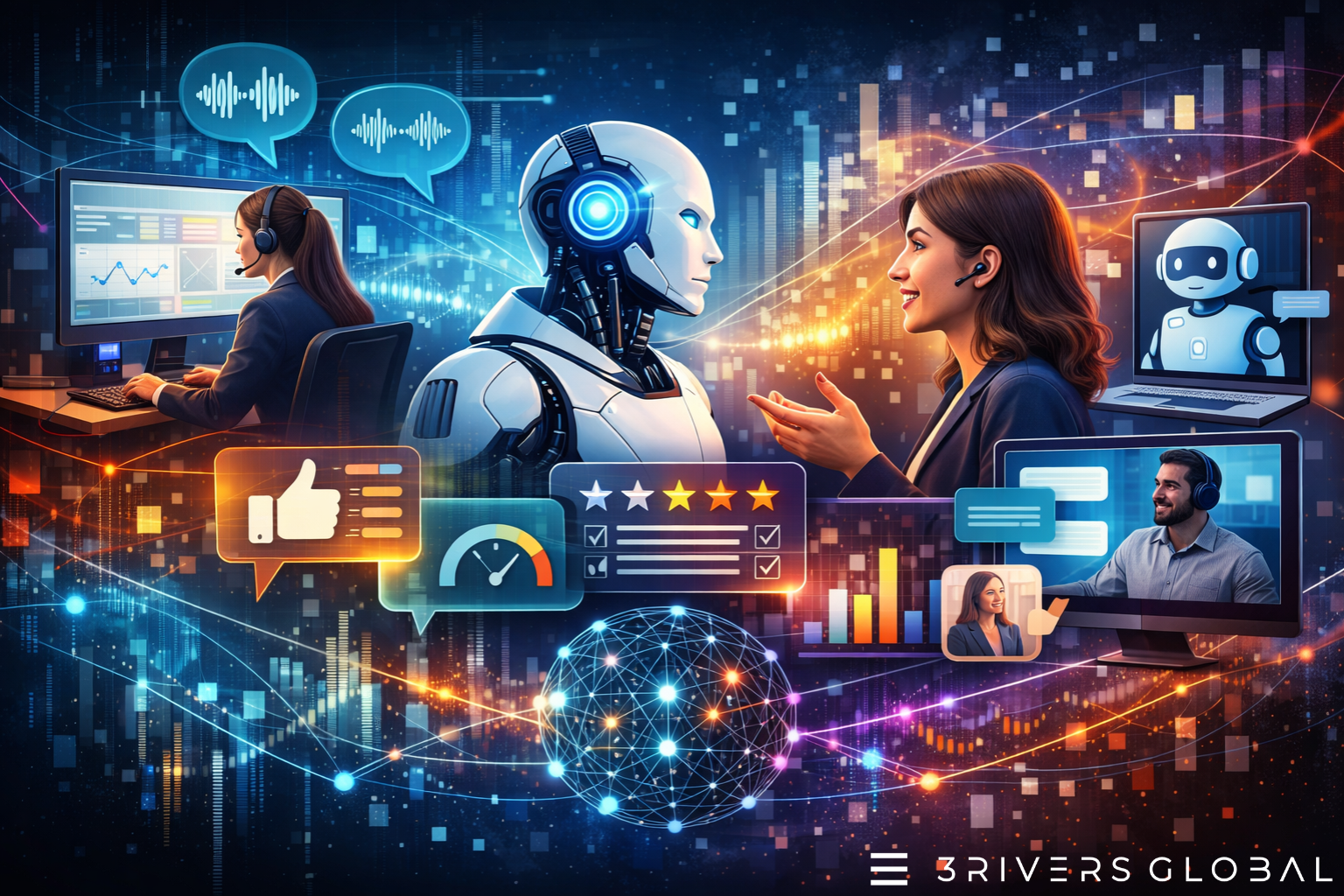
Quality Management (QM) has long been the quiet backbone of customer experience. It set standards, measured performance, and helped organizations ensure customers received the experience their brand promised. But as AI-driven interactions rapidly scale across voice, chat, messaging, and self-service, many CX teams are discovering something uncomfortable: their QM programs were never designed for this world.
AI isn’t just changing how customers interact with businesses. It’s fundamentally reshaping what quality means — and how it must be managed.
The Hidden Gaps AI Is Exposing in CX
As AI-led conversations grow, organizations are uncovering blind spots they didn’t expect:
- AI interactions happen at scale and speed that human-only QA models can’t keep up with.
- Traditional sampling methods miss patterns buried across thousands — or millions — of automated conversations.
- Inconsistent experiences emerge when AI agents, bots, and human agents operate under different quality standards.
The result? Leaders may believe quality is under control, while customers experience variability, confusion, or frustration that goes unseen.
When QM Was Built for Humans Only
Most QM programs were designed around a simple assumption: every interaction involved a human agent.
That assumption shaped:
- Manual scorecards
- Limited call or chat sampling
- Post-interaction reviews focused on agent behavior
In an AI-enabled environment, this approach breaks down. AI doesn’t get tired, emotional, or distracted — but it can still:
- Misinterpret intent
- Apply rules inconsistently
- Drift from brand voice over time
- Escalate incorrectly or too late
If quality frameworks don’t evaluate AI behavior with the same rigor as human performance, organizations risk managing only half the experience.
Redefining Quality Across Human and AI Interactions
Modern Quality Management must evolve from agent-centric to experience-centric.
That shift requires:
- Unified quality standards applied consistently to both human and AI-led interactions
- Conversation-level visibility across channels, not just sampled reviews
- Context-aware analysis that understands intent, sentiment, resolution, and outcomes
When done well, QM becomes less about scoring and more about confidence — confidence that every interaction reflects the brand’s promise.
Where Traditional QM Breaks — and What AI Unlocks
Traditional QM struggles in three key areas:
- Scale – Sampling can’t reflect reality in AI-heavy environments.
- Consistency – Different evaluators, tools, and frameworks lead to fragmented insights.
- Depth – Manual reviews miss emerging trends, edge cases, and systemic issues.
Modern AI-powered QM tools change the equation by:
- Analyzing 100% of interactions
- Detecting patterns humans would never see
- Identifying friction points across journeys, not just moments
- Surfacing insights in near real time
These capabilities don’t replace human judgment — they amplify it.
Visibility Is the New Quality Advantage
In an AI-driven CX world, visibility is everything.
Organizations that thrive are those that can:
- See how AI and humans perform together
- Understand where experiences break down before customers complain
- Continuously tune models, scripts, and workflows based on real data
Quality Management becomes a strategic asset — one that directly influences trust, loyalty, and growth.
How 3Rivers Global LLC Helps Organizations Stay Ahead
At 3Rivers Global, we help organizations rethink Quality Management as part of a broader digital business transformation.
Our approach focuses on:
- Aligning QM strategy with AI adoption and CX goals
- Designing unified quality frameworks for human and AI interactions
- Improving visibility across the full customer journey
- Turning quality insights into measurable performance and growth outcomes
By helping leaders connect quality, technology, and transformation, we enable organizations to stay ahead of the energy curve—and deliver experiences that consistently reflect their brand promise.
Quality in the Age of AI Is About Confidence
AI isn’t eroding Quality Management — it’s forcing it to evolve.
Organizations that modernize their QM programs gain something invaluable: confidence. Confidence that every interaction, human or AI, delivers clarity, consistency, and trust. And confidence that quality is no longer a rearview metric, but a forward-looking driver of extraordinary growth.
Leave a Reply
You must be logged in to post a comment.