
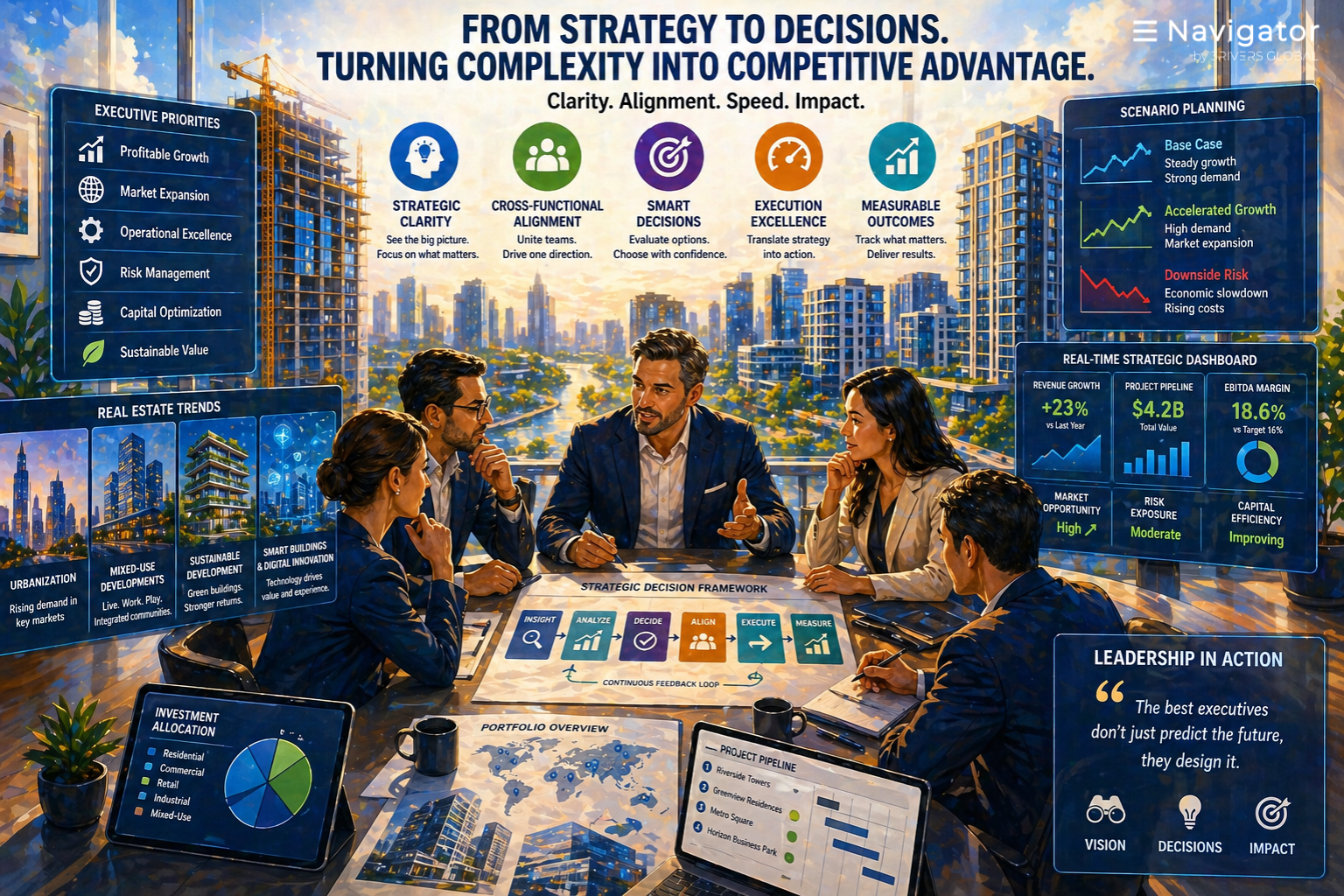
Leadership Has Always Been About Decisions. Now It’s About Decision Velocity
At the executive level, the role has always been clear:
- Set direction
- Allocate resources
- Drive performance
But the environment in which those decisions are made has fundamentally changed.
Today’s leaders face:
- Constant market volatility
- Rapid technological disruption
- Increasing organizational complexity
- Shorter windows for decision-making
The challenge is no longer just making the right decisions.
It is making the right decisions faster, with greater clarity, and with aligned execution.
The Core Constraint: Complexity Without Clarity
Modern organizations generate more data, more insights, and more signals than ever before.
Yet many executives still struggle with:
- Conflicting priorities across functions
- Delayed decision cycles
- Lack of alignment between strategy and execution
This creates a paradox:
More information, but less clarity.
The result:
- Slower execution
- Missed opportunities
- Organizational drift
Why Many Strategies Fail at the Executive Level
Even well-crafted strategies often fail, not because they are wrong, but because they are not operationalized.
Common breakdowns include:
1. Strategy as a Static Exercise
Annual planning cycles fail to keep up with real-time change.
2. Fragmented Leadership Alignment
Different functions interpret strategy differently.
3. Execution Gaps
There is no consistent mechanism to translate strategy into action.
4. Limited Scenario Planning
Decisions are made based on current conditions, not future possibilities.
The result:
Strong direction but inconsistent outcomes.
What High-Performing Leaders Do Differently
The most effective executives operate with a different approach.
They don’t just define strategy.
They operate a system of continuous decision-making.
They:
- Continuously evaluate scenarios
- Align decisions across functions
- Translate strategy into execution frameworks
They move from:
Periodic strategy setting
to
Continuous strategic orchestration
This is where platforms like Navigator by 3Rivers Global become a force multiplier.
How Navigator Comes Into Play in Executive Decision-Making
Navigator operates as a decision intelligence layer for leadership, enabling executives to move from analysis to action with precision.
It connects:
Strategy → Decisions → Execution → Outcomes
Here’s how it directly supports key executive use cases:
1. Strategic Scenario Planning (From Static to Dynamic)
Executives must evaluate multiple possible futures.
Navigator enables:
- Modeling of different market scenarios
- Stress-testing of strategic options
- Evaluation of risk vs opportunity
What changes:
From static planning → dynamic scenario-driven decision-making
2. Cross-Functional Alignment (From Silos to Synchronization)
Misalignment across functions slows execution.
Navigator helps:
- Align priorities across departments
- Translate strategy into function-specific actions
- Ensure consistency in execution
What changes:
From fragmented execution → synchronized organizational movement
3. Decision Prioritization (From Overload to Focus)
Executives face an overwhelming number of decisions.
Navigator enables:
- Identification of high-impact decisions
- Structured prioritization frameworks
- Clear sequencing of actions
What changes:
From decision overload → focused, high-leverage execution
4. Growth Strategy Execution (From Vision to Outcomes)
Growth strategies often fail in execution.
Navigator helps:
- Translate growth objectives into actionable plans
- Align investments with strategic priorities
- Track execution against outcomes
What changes:
From aspirational growth → execution-driven growth strategy
5. Real-Time Strategic Insight (From Lagging to Leading Indicators)
Traditional reporting focuses on past performance.
Navigator enables:
- Forward-looking insights
- Real-time strategic adjustments
- Continuous feedback loops
What changes:
From reactive leadership → proactive, adaptive leadership
The Real Shift: From Strategy Leadership to System Leadership
Traditional executive leadership focuses on setting direction.
Modern leadership requires managing systems.
| Traditional Leadership | Modern Leadership |
|---|---|
| Periodic strategy | Continuous strategy |
| Top-down decisions | System-driven decisions |
| Delayed execution | Real-time execution |
| Siloed alignment | Integrated alignment |
Navigator enables this shift by ensuring:
- Strategy is continuously refined
- Decisions are informed and aligned
- Execution is consistent and measurable
Why This Matters Now
The pace of change is accelerating:
- Competitive cycles are shorter
- Disruption is constant
- Organizational complexity is increasing
In this environment, the advantage does not go to:
The organization with the best strategy
but to:
The organization that can execute decisions faster and more effectively
Final Thought
Leadership is no longer defined by vision alone.
It is defined by:
- Clarity of decisions
- Speed of execution
- Alignment of the organization
Because ultimately, success at the executive level is not about:
Having the right answers
but about:
Building a system that consistently produces them
And the defining question becomes:
Are you setting strategy, or operating a system that turns strategy into results?
Leave a Reply
You must be logged in to post a comment.