
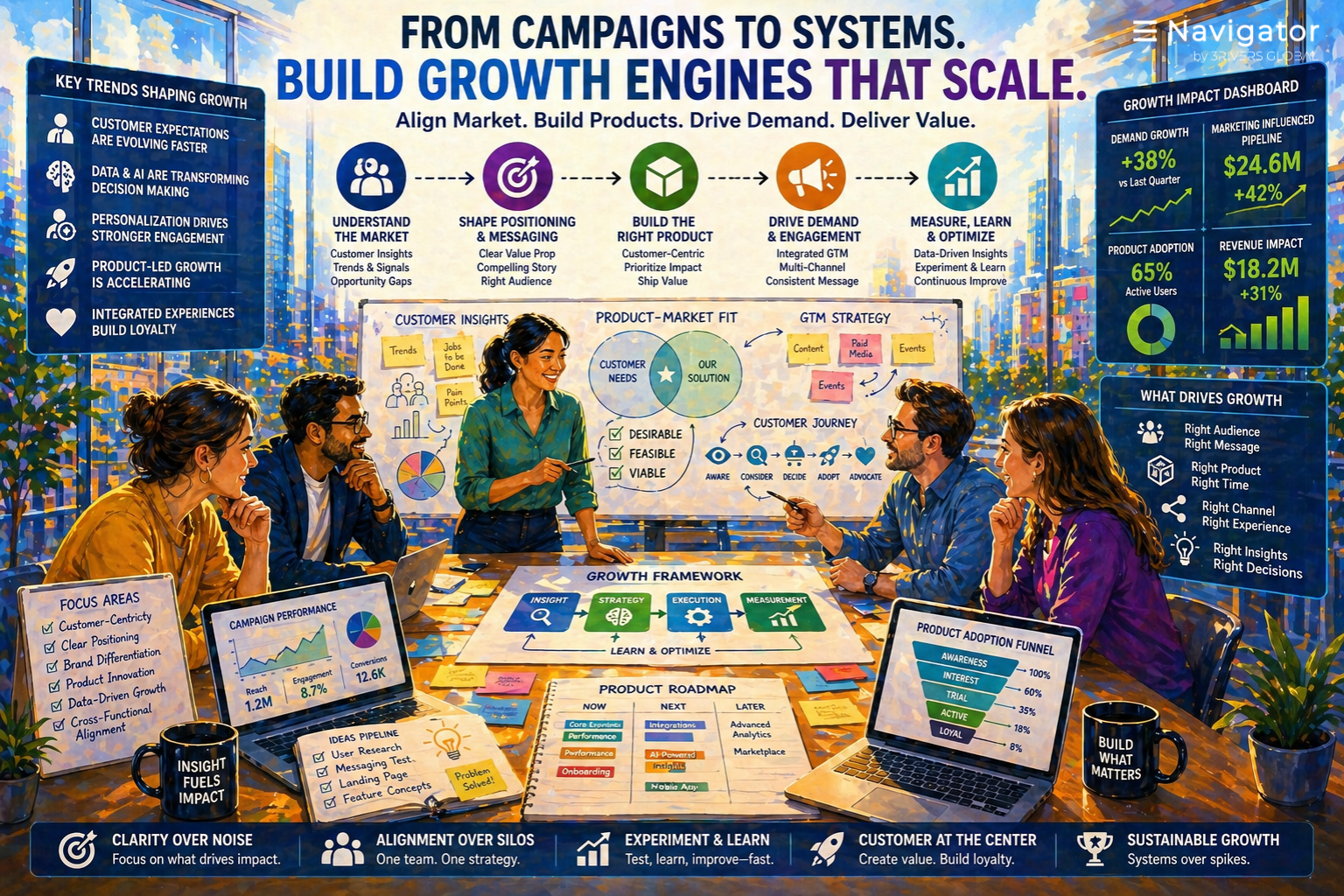
Growth Has Always Been the Goal—Now Alignment Is the Constraint
Marketing and product leaders have always been responsible for growth:
- Driving demand
- Shaping positioning
- Building products customers value
But today, the environment has changed dramatically:
- Customer journeys are fragmented across channels
- Competition is more intense and faster-moving
- Product expectations evolve continuously
- Data is abundant—but often underutilized
The challenge is no longer just generating growth.
It is aligning product, positioning, and execution into a system that consistently produces it.
The Core Problem: Disconnected Growth Functions
In many organizations, marketing and product operate in parallel:
- Marketing drives campaigns
- Product builds features
- Sales closes deals
But without alignment, this leads to:
- Messaging that doesn’t reflect product value
- Features that don’t drive demand
- Campaigns that don’t convert
The result:
Effort is high—but impact is diluted.
Why Many Growth Strategies Fall Short
Even sophisticated organizations struggle due to:
1. Campaign-Centric Thinking
Marketing focuses on short-term campaigns rather than long-term systems.
2. Product-Market Misalignment
Products evolve—but positioning does not keep pace.
3. Fragmented Customer Insights
Data is collected—but not translated into clear strategic direction.
4. Lack of Closed-Loop Feedback
Insights from the market do not consistently inform product decisions.
The result:
Growth that is inconsistent, reactive, and difficult to scale.
What High-Performing Leaders Do Differently
The most effective marketing and product leaders don’t just run campaigns or build features.
They design growth systems.
They focus on:
- Continuous product-market alignment
- Data-driven decision-making
- Integrated execution across functions
They move from:
Running campaigns and shipping features
to
Building engines that drive sustained growth
This is where platforms like Navigator by 3Rivers Global become a strategic differentiator.
How Navigator Comes Into Play in Marketing & Product Leadership
Navigator acts as a growth intelligence and execution layer, enabling leaders to align product, market, and messaging.
It connects:
Customer Insight → Positioning → Product → Demand → Conversion
Here’s how it directly supports key use cases:
1. Product-Market Alignment (From Assumption to Precision)
Understanding the market is foundational.
Navigator enables:
- Continuous evaluation of customer needs
- Identification of gaps between product and demand
- Refinement of positioning in real time
What changes:
From assumed fit → continuously validated alignment
2. Go-To-Market Strategy (From Campaigns to Systems)
Marketing often focuses on isolated campaigns.
Navigator helps:
- Define cohesive GTM strategies
- Align messaging across channels
- Structure repeatable demand generation systems
What changes:
From campaign bursts → sustainable growth engine
3. Customer Journey Design (From Touchpoints to Experience)
Customer journeys are increasingly complex.
Navigator enables:
- Mapping of end-to-end journeys
- Identification of friction points
- Alignment of product and marketing with customer behavior
What changes:
From disconnected touchpoints → seamless customer experience
4. Data-Driven Decision Making (From Metrics to Insight)
Marketing and product teams track many metrics—but struggle to prioritize.
Navigator helps:
- Identify the most impactful KPIs
- Translate data into actionable insights
- Align decisions with growth objectives
What changes:
From data overload → decision clarity
5. Growth Experimentation & Optimization (From Testing to Learning Systems)
Experimentation is often ad hoc.
Navigator enables:
- Structured experimentation frameworks
- Identification of high-impact tests
- Continuous optimization loops
What changes:
From isolated experiments → systematic growth learning
The Real Shift: From Functions to Growth Systems
Traditional organizations treat marketing and product as separate functions.
Modern organizations integrate them into a system.
| Traditional Model | Evolving Model |
|---|---|
| Campaign-driven marketing | System-driven growth |
| Feature-driven product | Market-aligned product |
| Siloed execution | Integrated execution |
| Reactive optimization | Continuous improvement |
Navigator enables this shift by ensuring:
- Product and market stay aligned
- Messaging reflects real value
- Execution is structured and scalable
Why This Matters Now
Marketing and product leaders face increasing pressure:
- Deliver consistent growth
- Improve efficiency of acquisition
- Align across product, marketing, and sales
At the same time, the opportunity to scale has never been greater.
The difference lies in:
How effectively leaders can turn growth into a system—not just a result.
Final Thought
Marketing and product teams do not fail because of lack of effort.
They fail because effort is not aligned into a system.
Because in today’s environment, success is not defined by:
The number of campaigns launched or features released
but by:
How effectively those efforts translate into sustained growth
And the defining question becomes:
Are you running campaigns and building features—or creating a system that drives continuous growth?
Leave a Reply
You must be logged in to post a comment.