
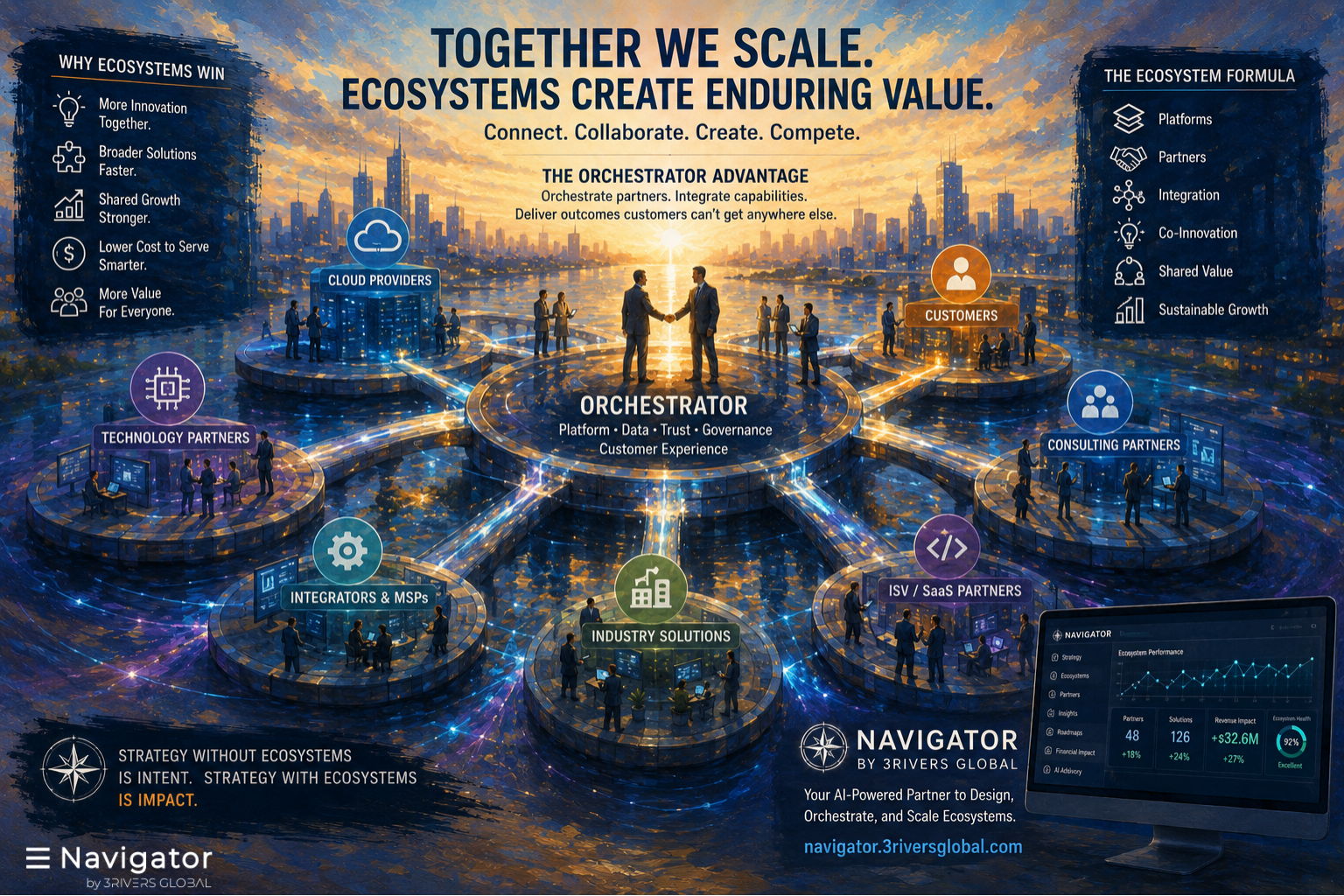
Why the Future Belongs to Organizations That Learn to Orchestrate, Not Just Compete
For much of modern business history, companies were taught to focus on becoming stronger, larger, and more self-sufficient.
Success was often measured by how much an organization could build internally.
More products.
More capabilities.
More departments.
More control.
The prevailing belief was simple:
The stronger the enterprise, the greater the competitive advantage.
That philosophy helped create many successful organizations.
But the business environment has changed.
Today’s challenges are more complex, technologies evolve faster, customer expectations are higher, and innovation cycles are shorter than ever before.
No organization—regardless of size, budget, or market position—can realistically build everything customers need.
The companies shaping the future understand something increasingly important:
Competitive advantage is no longer created by individual organizations alone. It is created by ecosystems.
The winners of the next decade will not necessarily be the companies with the most resources.
They will be the organizations that build the strongest networks.
The End of the Standalone Enterprise
For decades, businesses operated as largely self-contained entities.
A company designed products, delivered services, managed operations, and controlled customer relationships.
This model worked reasonably well when markets evolved slowly.
Today, however, businesses must navigate a world shaped by:
- Artificial intelligence
- Cloud computing
- Cybersecurity threats
- Digital transformation
- Remote and hybrid work
- Data-driven decision making
- Constant customer expectations
The breadth of expertise required has become too vast for any single organization to master alone.
Even the largest enterprises increasingly rely on specialized partners, platforms, developers, technology vendors, consultants, distributors, and service providers.
The modern organization is no longer an island.
It is a node within a larger network.
Why Ecosystems Are Winning
An ecosystem is more than a collection of partnerships.
It is a coordinated network of organizations that collectively create value for customers.
Unlike traditional partnerships, ecosystems are designed intentionally.
Participants contribute different capabilities while benefiting from shared growth and mutual success.
This model creates several advantages.
1. Faster Innovation
Innovation rarely happens in isolation.
Some organizations excel at technology.
Others excel at customer engagement.
Others specialize in industry expertise.
An ecosystem allows these capabilities to combine, accelerating innovation far beyond what any participant could achieve independently.
2. Expanded Capabilities
Customers increasingly seek integrated solutions rather than fragmented products and services.
Ecosystems allow organizations to expand offerings without having to build every capability themselves.
This creates broader value while reducing investment requirements.
3. Greater Agility
Market conditions change quickly.
Organizations embedded within strong ecosystems can adapt more rapidly because they have access to specialized expertise, resources, and solutions when needed.
4. Network Effects
The most powerful ecosystems become stronger as more participants join.
Every new partner, customer, provider, or contributor increases the value of the ecosystem for everyone involved.
This creates a competitive advantage that becomes increasingly difficult to replicate.
The Three Roles in Every Ecosystem
Not all ecosystem participants play the same role.
Understanding this distinction is essential.
The Specialist
Specialists provide focused expertise.
They solve specific problems exceptionally well.
Examples include:
- Cybersecurity providers
- Data analytics firms
- Industry consultants
- Software developers
Specialists are valuable because they deepen ecosystem capabilities.
The Enabler
Enablers provide foundational technologies and infrastructure.
They create capabilities that others can leverage.
Examples include:
- Cloud providers
- Software platforms
- AI infrastructure providers
- Connectivity providers
Their value lies in enabling others to create solutions.
The Orchestrator
The orchestrator occupies the most strategic position.
Orchestrators:
- Coordinate participants
- Create standards
- Manage customer experiences
- Connect capabilities
- Facilitate value exchange
Most importantly, orchestrators become the center of gravity for the ecosystem.
This distinction explains why some organizations capture disproportionate value despite not delivering every component themselves.
The Orchestrator Advantage
In traditional business thinking, ownership creates value.
In ecosystem thinking, orchestration creates value.
The orchestrator does not necessarily provide every service.
Instead, it ensures the customer receives a seamless, integrated outcome.
Customers rarely want multiple disconnected vendors.
They want solutions.
They want simplicity.
They want accountability.
The orchestrator becomes the organization that brings everything together.
This role offers several advantages:
- Stronger customer relationships
- Greater visibility across the value chain
- Expanded revenue opportunities
- Higher switching costs
- Enhanced strategic influence
In many cases, orchestrators capture more value than the individual participants delivering specific components.
Why Partnerships Alone Are Not Enough
Many organizations proudly announce partnership after partnership.
Yet relatively few build true ecosystems.
There is an important difference.
Partnerships are often transactional.
Ecosystems are strategic.
Partnerships may involve referrals, integrations, or joint marketing.
Ecosystems require:
- Shared objectives
- Coordinated value delivery
- Defined participant roles
- Common standards
- Sustainable economic models
Without these elements, organizations simply accumulate partnerships without creating meaningful network effects.
The future belongs not to organizations with the most partners.
It belongs to organizations that design the most effective ecosystems.
Ecosystems and Platform Economics
The rise of ecosystems is closely tied to the rise of platforms.
Platforms provide the foundation that allows ecosystem participants to interact efficiently.
They create:
- Shared infrastructure
- Standardized processes
- Unified experiences
- Data visibility
- Scalable collaboration
Without platforms, ecosystems become difficult to coordinate.
Without ecosystems, platforms struggle to maximize value.
The two concepts are increasingly inseparable.
This is why so many market leaders are simultaneously pursuing platform strategies and ecosystem strategies.
One reinforces the other.
The Leadership Shift Required
Building ecosystems requires leaders to rethink traditional assumptions.
Historically, leadership often focused on control.
Modern ecosystem leadership focuses on enablement.
Leaders must ask different questions:
Instead of:
“How do we build this ourselves?”
Ask:
“Who should we collaborate with?”
Instead of:
“How do we own every capability?”
Ask:
“Which capabilities should we orchestrate?”
Instead of:
“How do we maximize our share?”
Ask:
“How do we increase value for the entire ecosystem?”
Organizations that embrace this shift often discover that growth accelerates as ecosystem participants become invested in mutual success.
Why Navigator Reflects This Philosophy
The development of Navigator by 3Rivers Global has been heavily influenced by ecosystem thinking.
One of the lessons learned throughout years of working with organizations across telecommunications, managed services, technology, consulting, and digital transformation is that execution rarely succeeds in isolation.
Businesses need access to expertise.
They need frameworks.
They need tools.
They need trusted partners.
They need systems that help them move from strategy to action.
Navigator was never envisioned as a standalone application.
It was envisioned as a platform capable of connecting leaders, advisors, methodologies, frameworks, partners, and execution resources into a unified environment.
Its long-term value comes not only from what it does directly but from the ecosystem it enables.
In many ways, Navigator embodies the same principle driving the broader platform economy:
The future belongs to organizations that create connections, not just transactions.
The Next Competitive Battlefield
The next decade will not be defined by who has the biggest product catalog.
Or the largest workforce.
Or even the most advanced technology.
Increasingly, it will be defined by:
- Who builds the strongest ecosystem
- Who creates the most valuable network
- Who orchestrates the most effective collaboration
- Who enables others to succeed
This is the new competitive battlefield.
Organizations that remain isolated will find themselves competing against entire ecosystems.
Organizations that become ecosystem orchestrators will unlock opportunities far beyond their internal capabilities.
Building Something Bigger Than a Company
The most enduring organizations of the future will not think of themselves merely as businesses.
They will think of themselves as platforms for value creation.
They will connect people, expertise, technology, partners, and opportunities.
They will understand that success is no longer a solo endeavor.
Because in the digital economy, no one wins alone.
The organizations that learn to orchestrate ecosystems will define the next era of growth, innovation, and competitive advantage.
Leave a Reply
You must be logged in to post a comment.