
Why Transformation Is Never Finished
For decades, organizations approached transformation as an event.
A company would launch a major initiative, allocate a budget, assign a project team, implement new technology, and declare success once the project was complete.
Then they would return to business as usual.
That model no longer works.
Today’s business environment evolves too quickly for transformation to be treated as a one-time activity. Markets shift in months rather than years. New technologies emerge continuously. Customer expectations change rapidly. Competitive advantages disappear faster than ever before.
The organizations thriving today are not those that completed a transformation.
They are the organizations that learned how to continuously transform.
That distinction is profound.
Transformation is no longer the destination.
Transformation is the capability.
And building that capability has become the defining leadership challenge of our era.
The Problem With Fragmented Transformation
One of the most common reasons transformation efforts fail is that organizations attempt to improve isolated components rather than redesign the system as a whole.
Leadership launches a digital initiative.
Operations launches an automation program.
Marketing deploys new customer engagement tools.
Finance introduces new reporting systems.
Human Resources launches a workforce development program.
Each initiative may deliver localized benefits.
Yet the organization often experiences little meaningful improvement.
Why?
Because disconnected improvements rarely produce systemic outcomes.
Improving one part of the organization while neglecting the others is like upgrading the engine of a vehicle while ignoring the transmission, steering system, and brakes.
The individual component may improve.
The overall system may not.
In many cases, performance can actually deteriorate.
The challenge is not technology.
The challenge is integration.
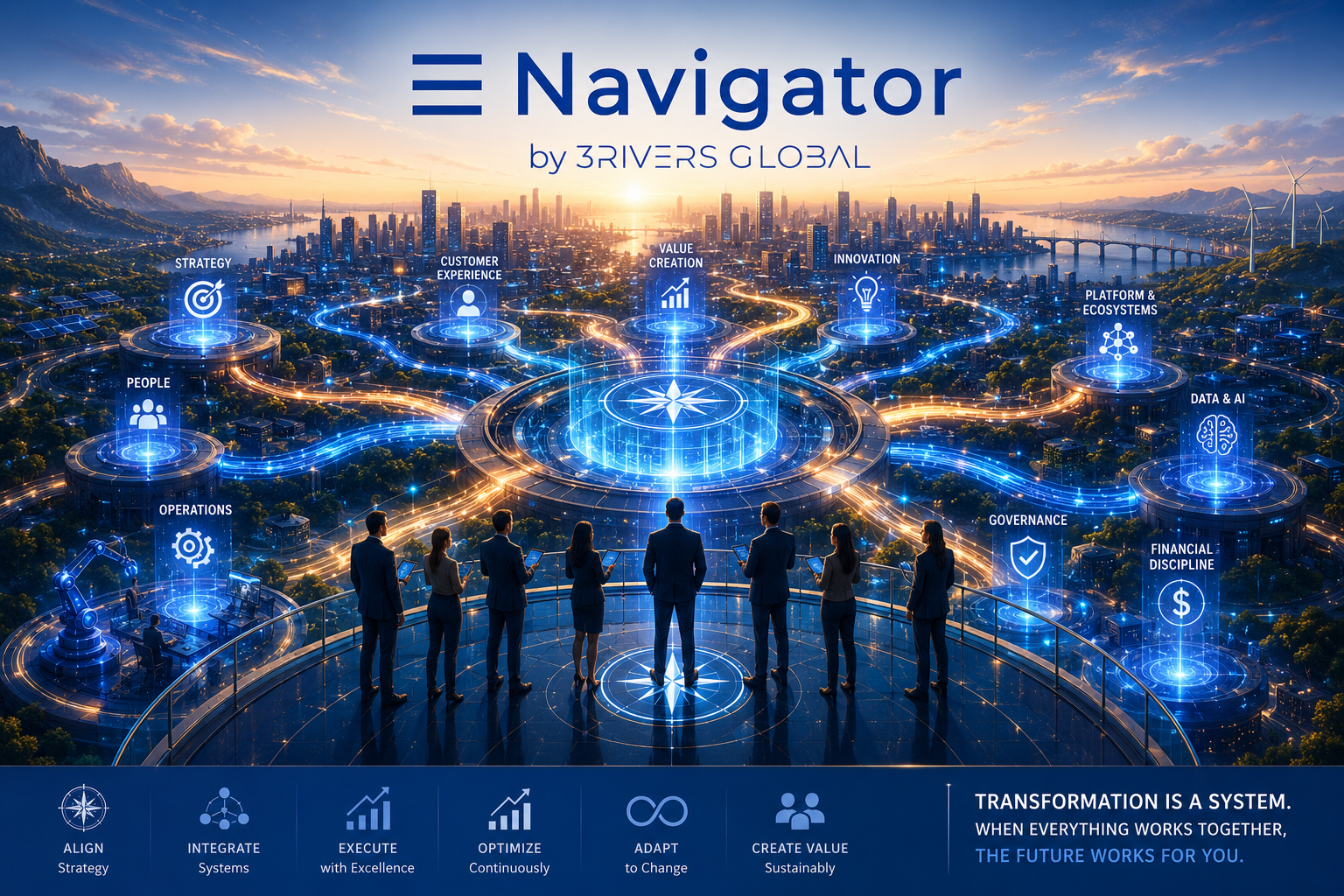
Transformation Is a System
The most important lesson learned from successful transformations across industries is that transformation must be approached as a system.
A transformation system consists of multiple interconnected elements working together toward a common objective.
These elements typically include:
- Strategic direction
- Customer and market intelligence
- Product and service innovation
- Operating models and capabilities
- Technology and infrastructure
- Go-to-market execution
- Governance and performance management
When these components reinforce one another, transformation becomes sustainable.
When they operate independently, transformation becomes fragmented.
The organizations achieving exceptional outcomes understand that success comes not from optimizing individual functions, but from aligning the entire system.
The New Playbook for the Platform Economy
The rise of digital platforms has fundamentally changed how value is created.
In the past, organizations competed primarily through scale, efficiency, and ownership of assets.
Today, they increasingly compete through ecosystems, platforms, data, and network effects.
Customers no longer buy isolated products.
They buy outcomes.
They buy experiences.
They buy integrated solutions.
This shift requires a new operating model.
Organizations must learn how to connect:
- Strategy with execution
- Technology with business outcomes
- Customer needs with innovation
- Ecosystems with monetization
- Data with decision-making
The winners in the platform economy will not be those with the most technology.
They will be those with the most aligned systems.
Why Continuous Transformation Matters
Continuous transformation is not about endless change.
It is about building organizational adaptability.
Organizations that continuously transform develop capabilities that allow them to:
- Respond to market disruption faster
- Identify opportunities earlier
- Deploy innovation more effectively
- Scale successful initiatives more rapidly
- Allocate capital more intelligently
- Reduce strategic risk
In practical terms, continuous transformation creates resilience.
When unexpected events occur—and they always do—adaptable organizations recover faster because change is already embedded into how they operate.
Transformation becomes part of their DNA.
Not an exception.
Not an initiative.
Not a special project.
Simply the way they work.
The Leadership Imperative
Technology alone cannot create a continuously transforming organization.
Leadership must.
Leaders shape priorities.
Leaders allocate resources.
Leaders determine incentives.
Leaders decide whether transformation is treated as a strategic capability or merely another project.
Organizations that successfully sustain transformation often share several characteristics:
They Align Around Outcomes
They measure success through business impact, not activity.
They Invest Beyond Technology
They invest in people, operating models, processes, and governance.
They Build Learning Systems
They continuously gather feedback, analyze results, and refine decisions.
They Embrace Ecosystems
They recognize that value increasingly comes from partnerships, platforms, and collaboration.
They Maintain Strategic Discipline
They know what to pursue—and equally important—what not to pursue.
These organizations understand that transformation is ultimately a leadership responsibility.
From Projects to Platforms
The future belongs to organizations that shift from project thinking to platform thinking.
Projects end.
Platforms evolve.
Projects solve individual problems.
Platforms create repeatable capabilities.
Projects consume resources.
Platforms generate leverage.
The same principle applies to transformation itself.
Organizations should not focus solely on completing transformation initiatives.
They should focus on building transformation platforms—systems that continuously identify opportunities, validate demand, deploy solutions, measure outcomes, and improve performance.
This is how transformation becomes scalable.
This is how it becomes sustainable.
This is how it creates lasting competitive advantage.
The Navigator Perspective
This philosophy is one of the foundational principles behind Navigator by 3Rivers Global.
Navigator was not created simply as another business planning tool.
It was designed to help leaders think and operate systematically.
The platform helps organizations connect strategy, execution, growth initiatives, operational improvement, innovation opportunities, and decision-making into a cohesive framework.
In a world overwhelmed by information, disconnected initiatives, and constant disruption, leaders increasingly need systems that help create alignment.
That is where transformation becomes practical.
That is where strategy becomes executable.
That is where organizations move from reacting to change to mastering it.
The Endgame
The endgame of transformation is not digital maturity.
It is not automation.
It is not artificial intelligence.
It is not cloud adoption.
Those are all important enablers.
The true endgame is building an organization capable of continuously adapting, learning, improving, and creating value regardless of how the external environment changes.
The organizations that master this capability will not merely survive future disruption.
They will shape it.
They will define new markets.
They will create new opportunities.
And they will remain relevant long after today’s technologies, trends, and competitive advantages have faded.
Because in the end, transformation is not about technology.
Transformation is about building a system that can continuously transform itself.
Leave a Reply
You must be logged in to post a comment.