
There was a time when the finance function was largely viewed as the guardian of the balance sheet.
Its role was to protect cash, control costs, ensure compliance, and provide visibility into the financial health of the organization.
Those responsibilities remain important.
But they are no longer sufficient.
Today, finance leaders find themselves at the center of one of the most consequential shifts in modern business history.
Artificial intelligence is reshaping industries.
Digital platforms are redefining competitive advantage.
Customer expectations continue to evolve at unprecedented speed.
Entire business models are being challenged by new entrants that often have fewer assets, fewer employees, and far greater agility.
Against this backdrop, the Chief Financial Officer has become something much larger than the steward of financial performance.
The CFO has become the steward of transformation.
And that responsibility carries a difficult question:
How do you fund the future without financing expensive mistakes?
The Growing Cost of Standing Still
For decades, many organizations evaluated investments using relatively stable assumptions.
Markets moved at predictable speeds.
Competitive landscapes changed gradually.
Technology upgrades were often incremental.
Today, those assumptions no longer hold.
The greatest risk facing many organizations is not making the wrong investment.
It is making no meaningful investment at all.
Companies that delay modernization efforts often discover that the cost of inaction compounds quietly.
Technical debt accumulates.
Operational inefficiencies persist.
Customer acquisition costs increase.
Employees become less productive.
Competitors gain ground.
What appears to be prudence can eventually become a strategic liability.
Yet the opposite extreme is equally dangerous.
Organizations that pursue transformation without clear business outcomes often spend millions implementing technologies that fail to produce measurable value.
This leaves finance leaders trapped between two competing risks:
Invest too little and the organization falls behind.
Invest too much in the wrong initiatives and shareholder value erodes.
The challenge is not whether to invest.
The challenge is knowing where to invest.
Why Many Transformation Programs Fail Financially
Most failed transformation initiatives have something in common.
The technology worked.
The economics did not.
Cloud migrations complete successfully.
New platforms are deployed.
Automation tools are implemented.
Employees receive training.
Yet revenue growth fails to materialize.
Margins remain stagnant.
Customer retention does not improve.
Productivity gains never fully emerge.
The problem is rarely technical.
It is financial.
Many organizations evaluate transformation through the lens of activity rather than outcomes.
Projects are approved because they sound innovative.
Budgets are justified because competitors are pursuing similar initiatives.
Technology roadmaps become disconnected from investment theses.
In effect, transformation becomes an expense category rather than an investment portfolio.
A CFO’s role is to challenge that thinking.
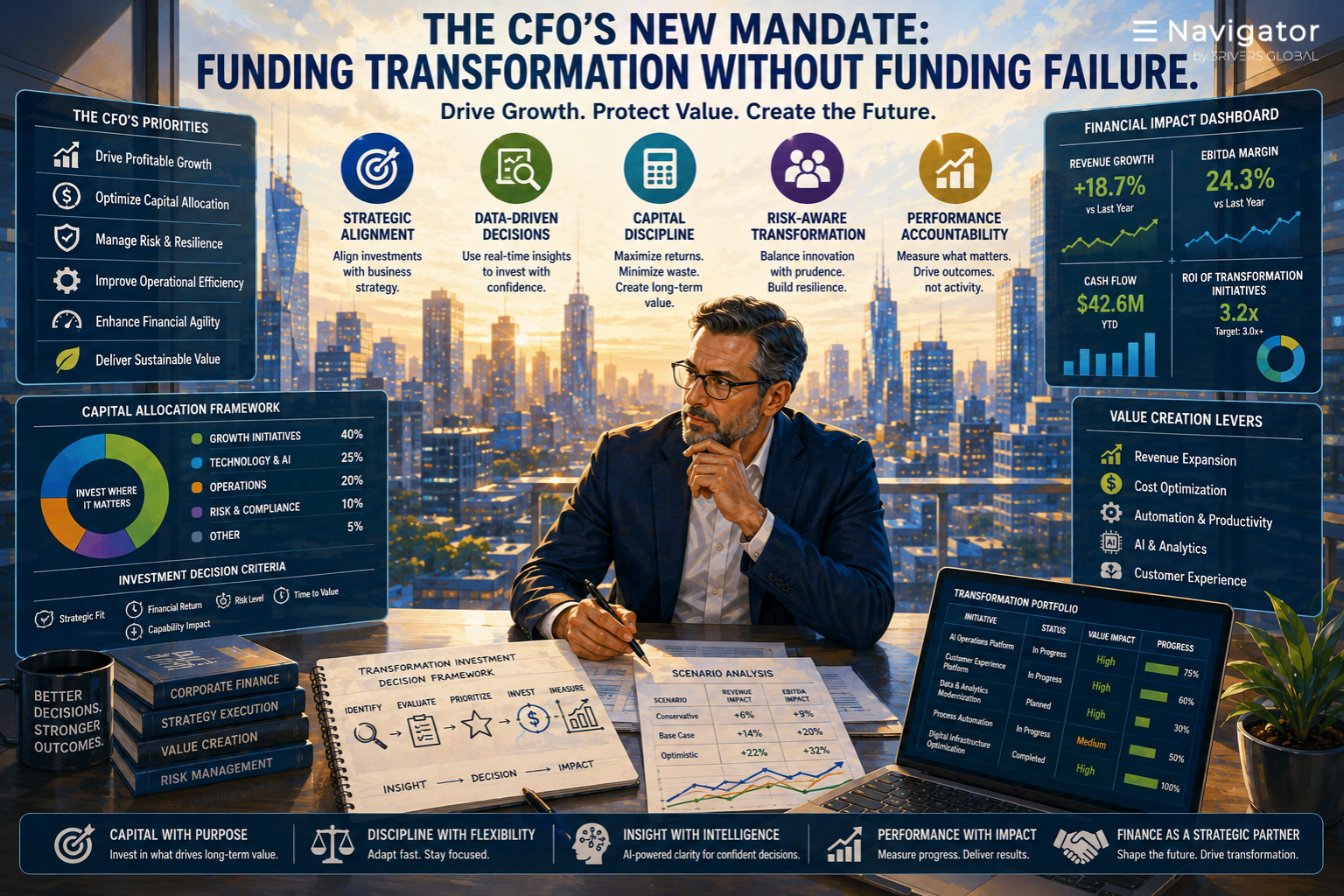
Every transformation initiative should answer the same questions investors would ask:
What value will be created?
How much value?
Over what period?
What risks exist?
How will success be measured?
Without those answers, transformation becomes speculation.
The Rise of Capital Discipline in the AI Era
Artificial intelligence has amplified this challenge.
Boards and executive teams are under pressure to “do something with AI.”
The enthusiasm is understandable.
The potential is enormous.
However, many organizations are discovering that AI initiatives can quickly become expensive experiments if not tied directly to business outcomes.
The most successful finance leaders are shifting the conversation away from technology adoption and toward value realization.
Instead of asking:
“Where can we use AI?”
They ask:
“Where can AI improve revenue, margins, customer experience, or productivity?”
This subtle shift changes everything.
The first question creates projects.
The second creates investment cases.
And investment cases are what finance organizations are designed to evaluate.
The Emergence of the Strategic CFO
The CFO role itself is evolving.
Historically, finance leaders focused on reporting the business.
Increasingly, they are expected to shape the business.
This requires capabilities that extend beyond accounting and financial planning.
Modern finance leaders must understand:
- Digital business models
- Platform economics
- Customer acquisition economics
- AI-enabled productivity
- Operational scalability
- Data-driven decision making
The organizations outperforming their peers are often those where finance leaders participate actively in strategy discussions rather than simply validating budgets after decisions have been made.
The CFO is no longer the final checkpoint.
The CFO is becoming a co-architect of growth.
Why Visibility Has Become a Competitive Advantage
One of the greatest challenges facing leadership teams today is not a lack of data.
It is the inability to transform information into decisions.
Finance teams have access to more dashboards, reports, metrics, and forecasts than at any point in history.
Yet many executives still struggle to answer fundamental questions:
Which initiatives deserve additional investment?
Which markets offer the greatest growth potential?
Where are execution bottlenecks occurring?
What risks are emerging?
Which strategic assumptions are proving incorrect?
The speed at which organizations can answer these questions increasingly determines their ability to compete.
Visibility is no longer a reporting function.
It is a strategic capability.
Organizations capable of connecting strategy, execution, and financial performance gain a significant advantage over those operating with fragmented information.
The Next Frontier: Finance-Led Transformation
The future belongs to organizations that treat transformation as a capital allocation discipline rather than a technology initiative.
The finance function is uniquely positioned to lead this shift.
It already possesses the analytical rigor, governance structures, and performance management capabilities required to evaluate investments objectively.
What changes is the scope of responsibility.
Finance leaders must move from measuring performance to helping design it.
From tracking outcomes to influencing them.
From protecting value to creating it.
The organizations that thrive over the next decade will not necessarily be those with the largest budgets.
They will be those with the strongest ability to identify opportunities, allocate capital intelligently, and execute with discipline.
That is fundamentally a finance challenge.
And increasingly, it is a CFO mandate.
Looking Ahead
As businesses navigate the intersection of AI, automation, digital platforms, and economic uncertainty, the role of finance will continue to expand.
The question is no longer whether transformation should occur.
The question is whether organizations can make transformation investments with enough clarity, confidence, and accountability to generate meaningful returns.
That requires more than spreadsheets.
It requires strategic intelligence.
It requires visibility across strategy and execution.
And it requires leaders willing to evaluate opportunities through the lens of measurable outcomes rather than technology trends.
The future will belong to organizations that can connect those dots faster than their competitors.
That is precisely why a growing number of leaders are embracing AI-powered platforms that help transform strategic thinking into informed action.
Not because technology itself is the answer.
But because better decisions remain the ultimate competitive advantage.
About Navigator by 3Rivers Global
Navigator by 3Rivers Global helps business leaders, executives, entrepreneurs, and advisors accelerate strategic decision-making through AI-powered insights, business intelligence, industry-specific guidance, and execution-focused recommendations.
Whether evaluating transformation opportunities, assessing market expansion strategies, improving operational performance, or identifying growth initiatives, Navigator helps leaders move from uncertainty to action faster and with greater confidence.
Leave a Reply
You must be logged in to post a comment.