
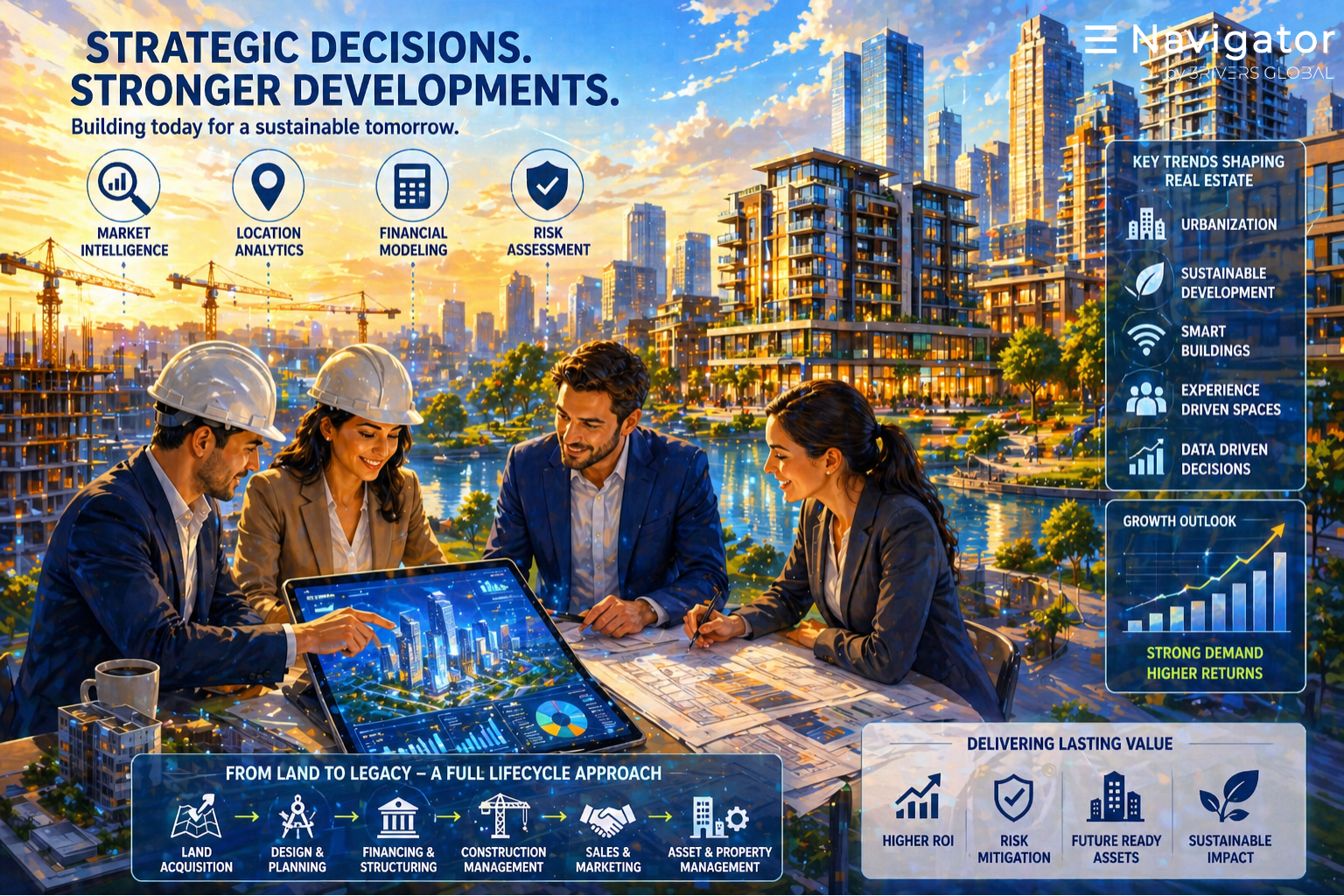
Real Estate Has Always Been About Location—Now It’s About Decisions
For decades, success in real estate development was driven by:
- Prime locations
- Capital access
- Timing of the market
While these still matter, they are no longer sufficient.
Today’s developers operate in a far more complex environment:
- Interest rate volatility
- Shifting demand patterns
- Regulatory constraints
- Evolving buyer and tenant expectations
The challenge is no longer just identifying opportunities.
It is making the right decisions across the entire lifecycle of development, and executing them with precision.
The Core Complexity: Multi-Layered Decision-Making
Every real estate project involves interconnected decisions:
- Site selection
- Capital structuring
- Design and positioning
- Sales and leasing strategy
- Portfolio balancing
Each decision impacts:
- Risk exposure
- Return potential
- Timeline
Without a structured approach, this complexity leads to:
- Misaligned investments
- Delays in execution
- Suboptimal returns
Why Many Development Strategies Fall Short
Even experienced developers encounter challenges when:
1. Decisions Are Made in Isolation
Site selection, financing, and sales strategies are often not fully aligned.
2. Market Signals Are Underutilized
Data exists, but is not translated into actionable insights.
3. Portfolio Strategy Is Reactive
Developments are pursued individually rather than as part of a broader portfolio strategy.
4. Execution Lacks Coordination
Stakeholders across design, construction, and sales are not fully aligned.
The result:
Strong projects, but inconsistent portfolio performance.
What Leading Developers Do Differently
Top-performing developers operate with a broader lens.
They don’t just build projects.
They design systems of investment and execution.
They focus on:
- Portfolio-level optimization
- Data-informed decision-making
- Integrated execution across stakeholders
They move from:
Managing individual developments
to
Orchestrating a strategic portfolio
This is where platforms like Navigator by 3Rivers Global become increasingly valuable.
How Navigator Comes Into Play in Real Estate Development
Navigator acts as a strategic intelligence and alignment layer, enabling developers to connect market insight with execution decisions.
It aligns:
Market Demand → Capital → Development → Sales → Returns
Here’s how it directly supports key use cases:
1. Portfolio Strategy Optimization (From Projects to Portfolio Thinking)
Many developers evaluate projects individually.
Navigator enables:
- Balancing of residential, commercial, and mixed-use assets
- Alignment of investments with market demand
- Optimization of risk-return profiles across the portfolio
What changes:
From project-by-project decisions → portfolio-level strategy
2. Market Feasibility Analysis (From Intuition to Insight)
Identifying the right opportunity is critical.
Navigator helps:
- Analyze demand trends by location and segment
- Evaluate competitive landscape
- Identify high-growth areas and property types
What changes:
From intuition-driven site selection → data-informed opportunity identification
3. Capital Structuring & Financing Strategy (From Access to Optimization)
Financing decisions significantly impact returns.
Navigator enables:
- Structuring of capital stacks
- Evaluation of funding options
- Modeling of financial scenarios
What changes:
From available financing → optimized capital strategy
4. Sales & Leasing Strategy (From Launch to Absorption)
Selling or leasing units efficiently is key to project success.
Navigator helps:
- Identify target buyer/tenant segments
- Design pricing and positioning strategies
- Optimize go-to-market timing
What changes:
From reactive sales → structured absorption strategy
5. Smart Property & Digital Integration (From Buildings to Experiences)
Modern developments are no longer just physical spaces.
Navigator enables:
- Integration of digital capabilities into properties
- Alignment of technology with tenant expectations
- Identification of value-added features
What changes:
From static assets → intelligent, experience-driven properties
The Real Shift: From Development Execution to Strategic Orchestration
Traditional real estate development focuses on executing projects effectively.
Modern development requires integration across the entire lifecycle.
| Traditional Approach | Evolving Approach |
|---|---|
| Project-focused | Portfolio-focused |
| Intuition-driven | Data-informed |
| Isolated decisions | Integrated strategy |
| Execution-heavy | Orchestration-driven |
Navigator enables this shift by ensuring:
- Decisions are aligned across stages
- Market data informs strategy
- Execution is coordinated across stakeholders
Why This Matters Now
Real estate developers face increasing pressure:
- Market volatility
- Rising costs
- Changing demand dynamics
- Greater competition
At the same time, opportunities remain significant for those who can navigate complexity effectively.
The difference lies in:
How well developers connect insight to execution.
Final Thought
Real estate developers will not win by building more.
They will win by building smarter.
Because in today’s environment, success is not defined by:
The number of projects completed
but by:
The quality, alignment, and performance of the systems behind those projects
And the defining question becomes:
Are you executing developments, or orchestrating a portfolio designed for sustained success?
Leave a Reply
You must be logged in to post a comment.