
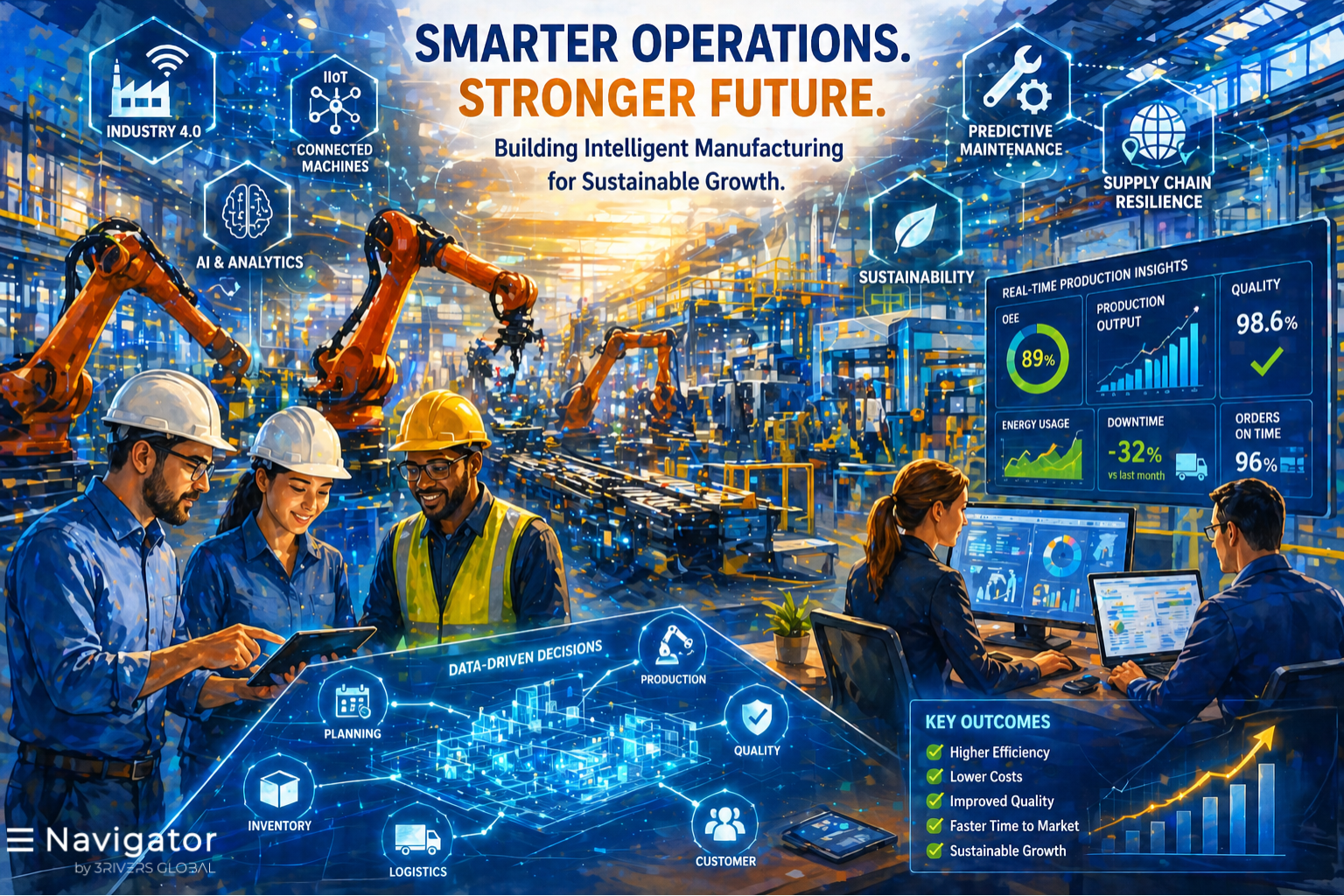
Manufacturing Is No Longer Just About Making Things
For decades, manufacturing success was defined by:
- Output volume
- Cost efficiency
- Operational consistency
But today, the landscape has changed.
Manufacturers are now competing on:
- Speed and responsiveness
- Supply chain resilience
- Product innovation
- Data-driven operations
The question is no longer:
“How efficiently can we produce?”
It is:
“How intelligently can we operate, adapt, and scale?”
The Core Challenge: Complexity Across the Value Chain
Modern manufacturing environments are highly interconnected:
- Suppliers
- Production lines
- Logistics networks
- Customers
Each layer introduces variability.
And disruptions—whether from supply chain shocks, demand shifts, or operational inefficiencies—can cascade across the entire system.
This creates a fundamental challenge:
Efficiency alone is no longer enough.
Resilience and adaptability must be built into the system.
Why Many Manufacturing Transformation Efforts Fall Short
Despite significant investment in Industry 4.0 technologies, many initiatives fail to deliver full value.
Common issues include:
1. Technology Without Integration
IoT, automation, and AI are deployed, but not connected to decision-making systems.
2. Siloed Operations
Production, supply chain, and planning functions operate independently.
3. Reactive Decision-Making
Adjustments are made after disruptions occur, not before.
4. Limited Visibility
Data exists, but is not translated into actionable insights.
The result:
Incremental improvements instead of transformational gains.
What Leading Manufacturers Do Differently
Top-performing manufacturers don’t just adopt technology.
They design intelligent operating systems.
They focus on:
- End-to-end visibility
- Integrated decision-making
- Continuous optimization
They move from:
Managing production
to
Orchestrating a connected, adaptive system
This is where platforms like Navigator by 3Rivers Global become increasingly critical.
How Navigator Comes Into Play in Manufacturing Transformation
Navigator acts as a strategic intelligence and execution layer, enabling manufacturers to connect data, operations, and decision-making.
It aligns:
Production → Supply Chain → Cost → Innovation → Performance
Here’s how it directly supports key use cases:
1. Smart Factory / Industry 4.0 Strategy (From Technology to System)
Many manufacturers invest in automation and IoT without a unified strategy.
Navigator helps:
- Define Industry 4.0 transformation roadmaps
- Align technology investments with business outcomes
- Prioritize initiatives based on ROI and impact
What changes:
From isolated tech adoption → integrated smart factory strategy
2. Supply Chain Resilience Planning (From Efficiency to Adaptability)
Traditional supply chains are optimized for cost, but not disruption.
Navigator enables:
- Identification of supply chain vulnerabilities
- Scenario modeling for disruptions
- Design of resilient sourcing and logistics strategies
What changes:
From cost-focused supply chains → resilient, adaptive networks
3. Cost Optimization & Productivity Improvement (From Cuts to Precision)
Cost reduction efforts often lack structure.
Navigator helps:
- Identify inefficiencies across operations
- Align cost optimization with productivity gains
- Model impact of operational improvements
What changes:
From reactive cost-cutting → data-driven productivity optimization
4. New Product Introduction (NPI) Strategy (From Delay to Acceleration)
Bringing new products to market is often slow and complex.
Navigator enables:
- Alignment of product development with market demand
- Identification of bottlenecks in NPI processes
- Structuring of faster, more efficient rollout strategies
What changes:
From delayed launches → accelerated time-to-market
5. Sustainability & ESG Strategy (From Compliance to Advantage)
Sustainability is no longer optional.
Navigator helps:
- Align ESG initiatives with operational strategy
- Identify efficiency gains tied to sustainability
- Model long-term impact of ESG investments
What changes:
From compliance-driven ESG → strategic sustainability advantage
The Real Shift: From Production Systems to Intelligence Systems
Traditional manufacturing focuses on optimizing individual components.
Modern manufacturing requires integration.
| Traditional Manufacturing | Modern Manufacturing |
|---|---|
| Output-focused | Intelligence-driven |
| Siloed operations | Integrated systems |
| Reactive adjustments | Predictive decisions |
Navigator enables this shift by ensuring:
- Data is connected across the value chain
- Decisions are informed by real-time insights
- Execution is aligned with strategy
Why This Matters Now
Manufacturers face increasing pressure:
- Supply chain volatility
- Rising input costs
- Demand unpredictability
- Sustainability requirements
At the same time, opportunities for transformation are significant.
The difference lies in:
How effectively manufacturers can connect insight to execution.
Final Thought
Manufacturers will not win by producing more.
They will win by operating smarter.
Because in today’s environment, success is not defined by:
How much you produce
but by:
How effectively you design and execute the systems behind that production
And the defining question becomes:
Are you optimizing production, or building an intelligent system that drives sustainable performance?
Leave a Reply
You must be logged in to post a comment.