
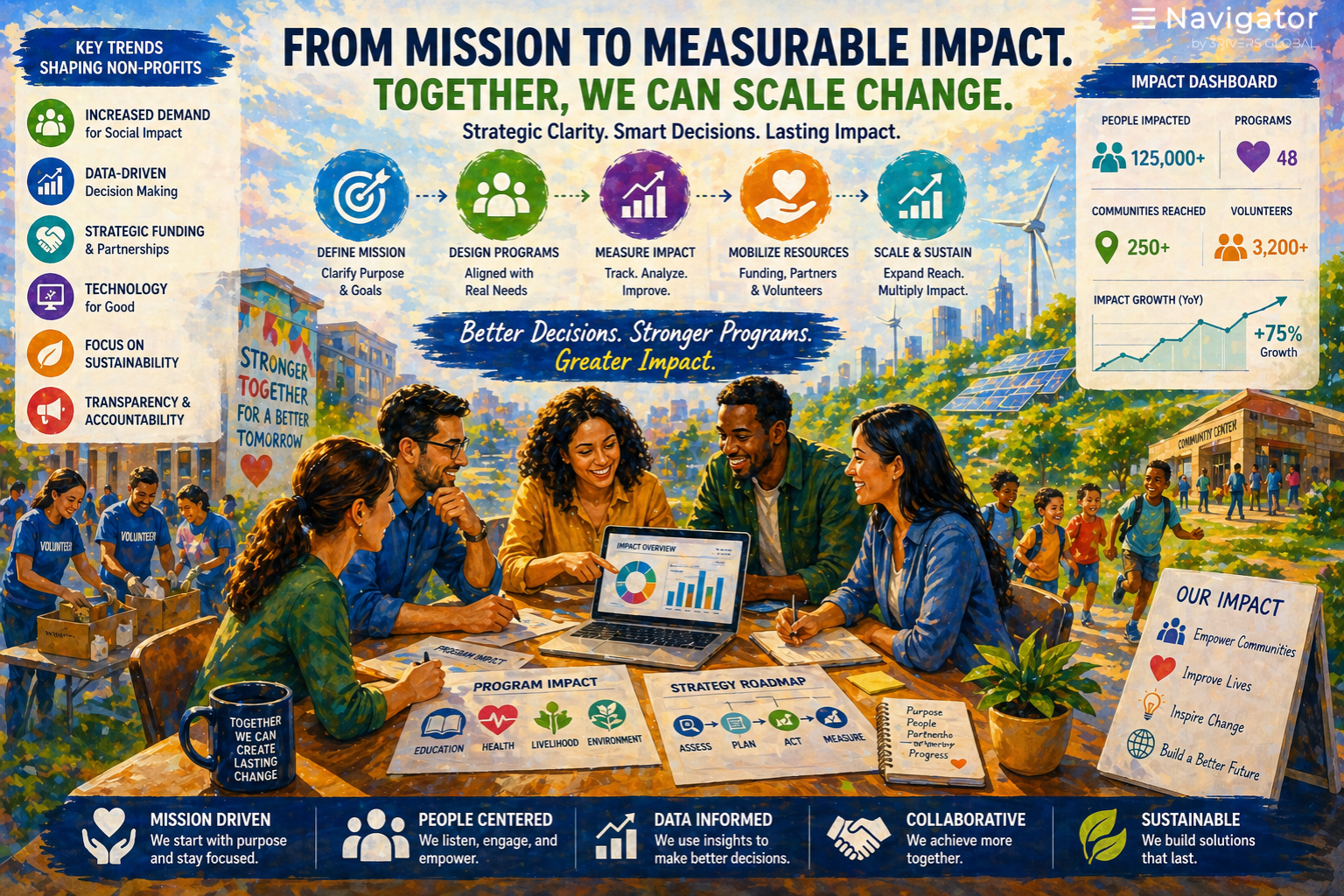
Purpose Has Always Driven Non-Profits—Now Impact Must Be Proven and Scaled
Non-profit organizations exist to solve some of the world’s most pressing challenges:
- Education gaps
- Healthcare access
- Social inequality
- Environmental sustainability
But the environment in which they operate has changed:
- Donors demand transparency and measurable outcomes
- Funding is increasingly competitive
- Beneficiary needs are evolving rapidly
The challenge is no longer just pursuing a mission.
It is delivering, measuring, and scaling impact consistently and sustainably.
The Core Constraint: High Expectations, Limited Resources
Non-profits operate under a unique set of constraints:
- Limited funding
- Lean teams
- Complex stakeholder ecosystems
At the same time, they are expected to:
- Demonstrate measurable outcomes
- Expand reach and scale programs
- Operate with increasing efficiency
This creates a fundamental tension:
How do you scale impact without scaling cost at the same rate?
Why Many Non-Profit Strategies Fall Short
Even with strong missions, many organizations struggle due to:
1. Fragmented Program Execution
Programs operate independently without system-level coordination.
2. Limited Data Utilization
Impact data exists—but is not fully leveraged for decision-making.
3. Reactive Funding Strategies
Organizations chase funding opportunities rather than aligning funding with strategy.
4. Measurement Challenges
Impact is difficult to quantify, making it harder to demonstrate value to stakeholders.
The result:
Meaningful work—but inconsistent, difficult-to-scale outcomes.
What High-Impact Non-Profits Do Differently
Leading organizations approach their mission with strategic discipline.
They:
- Align programs with clearly defined outcomes
- Use data to guide decisions
- Design systems that enable scale
They move from:
Running programs
to
Building systems that deliver measurable impact
This is where platforms like Navigator by 3Rivers Global play a transformative role.
How Navigator Comes Into Play in Non-Profit Impact Scaling
Navigator acts as a mission-aligned strategic intelligence layer, helping non-profits connect purpose with execution.
It aligns:
Mission → Programs → Funding → Operations → Impact
Here’s how it directly supports key use cases:
1. Program Design & Impact Alignment (From Activity to Outcomes)
Non-profits often measure success by activity rather than outcomes.
Navigator enables:
- Definition of clear impact goals
- Alignment of programs with measurable outcomes
- Identification of gaps between effort and impact
What changes:
From activity-based execution → outcome-driven program design
2. Funding Strategy Optimization (From Opportunity to Alignment)
Funding is often pursued reactively.
Navigator helps:
- Align funding sources with strategic priorities
- Identify sustainable funding models
- Structure proposals based on measurable impact
What changes:
From opportunistic funding → strategic funding alignment
3. Impact Measurement & Reporting (From Narrative to Evidence)
Demonstrating impact is critical for growth and credibility.
Navigator enables:
- Identification of key impact metrics
- Structuring of reporting frameworks
- Translation of data into compelling narratives
What changes:
From qualitative storytelling → data-backed impact reporting
4. Operational Efficiency (From Constraint to Optimization)
Limited resources require careful allocation.
Navigator helps:
- Identify inefficiencies across programs and operations
- Optimize resource allocation
- Align operations with impact priorities
What changes:
From resource strain → optimized operational efficiency
5. Scaling Initiatives (From Local Impact to Broader Reach)
Many non-profits struggle to expand beyond initial success.
Navigator enables:
- Identification of scalable program models
- Structuring of expansion strategies
- Alignment of partnerships and resources
What changes:
From localized success → scalable impact models
The Real Shift: From Mission-Driven to System-Driven Impact
Non-profits have always been mission-driven.
But scaling impact requires systems.
| Traditional Approach | Evolving Approach |
|---|---|
| Program-focused | System-focused |
| Activity-based metrics | Outcome-based metrics |
| Reactive funding | Strategic funding |
| Localized impact | Scalable models |
Navigator enables this shift by ensuring:
- Strategy aligns with mission
- Execution is structured
- Impact is measurable and scalable
Why This Matters Now
Non-profits face increasing pressure:
- Greater accountability from donors
- Increased competition for funding
- Rising expectations for measurable impact
At the same time, the need for their work has never been greater.
The difference lies in:
How effectively organizations can translate purpose into sustained, measurable outcomes.
Final Thought
Non-profits will not scale impact by doing more alone.
They will scale impact by doing:
- The right things
- In the right way
- With the right level of strategic clarity
Because in today’s environment, success is not defined by:
The number of initiatives launched
but by:
The depth, sustainability, and scalability of the impact delivered
And the defining question becomes:
Are you running programs—or building a system that delivers lasting change?
Leave a Reply
You must be logged in to post a comment.