
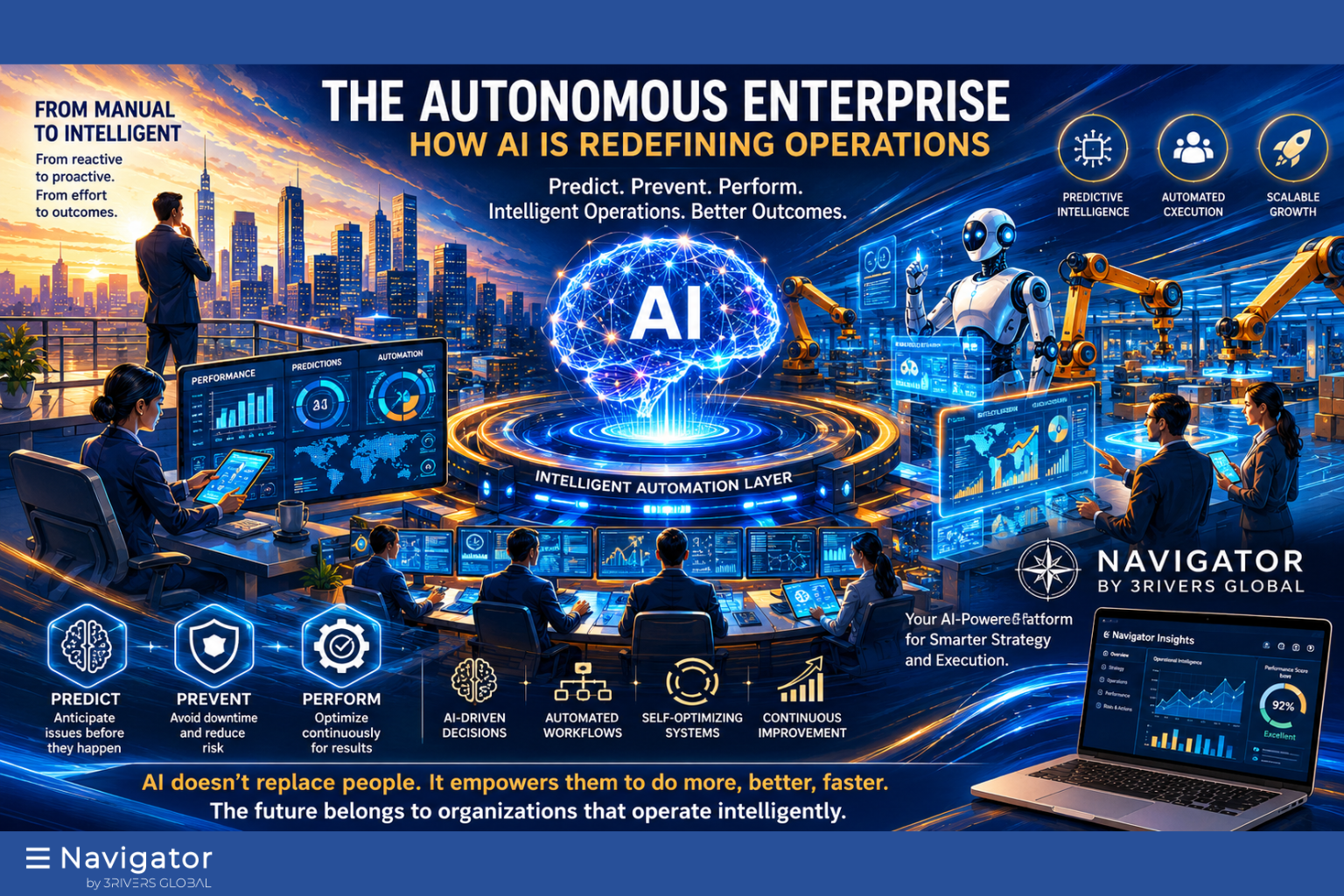
For decades, organizations pursued operational excellence through a familiar formula: hire talented people, build efficient processes, deploy technology, and continuously optimize.
That formula is not disappearing.
But it is being fundamentally rewritten.
Artificial Intelligence is no longer simply another technology investment. It is becoming the operating layer through which modern organizations execute, decide, optimize, and scale.
The most significant business transformation of this decade is not the adoption of AI tools.
It is the emergence of the Autonomous Enterprise.
Organizations that recognize this shift early will operate faster, make better decisions, reduce costs, improve customer experiences, and unlock entirely new growth opportunities.
Those that treat AI as a feature rather than a strategic capability risk falling behind.
The Evolution of Enterprise Operations
Enterprise operations have historically evolved through distinct eras.
The first era was manual.
Processes depended almost entirely on human effort. Decisions were based on experience, intuition, and historical reporting.
The second era was digital.
Organizations digitized workflows, introduced ERP systems, CRM platforms, cloud infrastructure, and workflow automation.
This improved efficiency but still required substantial human intervention.
Today, we are entering the third era.
The era of intelligent operations.
In this model, systems do not simply execute instructions.
They learn.
They predict.
They recommend.
And increasingly, they act.
The difference is profound.
Instead of employees searching for information, information finds employees.
Instead of reacting to problems, organizations predict them.
Instead of manually coordinating activities, intelligent systems orchestrate workflows across functions.
The enterprise becomes increasingly autonomous.
AI Is Moving Beyond Productivity
Much of the public discussion around AI focuses on productivity.
Writing assistance.
Meeting summaries.
Research support.
Content generation.
These applications are valuable, but they represent only the first wave.
The larger opportunity lies in operational intelligence.
Imagine a business where:
- Sales forecasts continuously adjust based on market signals.
- Supply chains proactively respond to disruptions before they occur.
- Customer service systems resolve issues before customers submit tickets.
- Financial models automatically identify profitability risks.
- Marketing campaigns self-optimize based on performance patterns.
- Infrastructure predicts failures before downtime occurs.
These capabilities are no longer theoretical.
They are becoming operational realities.
The organizations creating the greatest value from AI are not merely automating tasks.
They are redesigning how work gets done.
The Three Levels of AI Maturity
Many organizations mistakenly believe implementing AI tools means they are becoming AI-driven.
In reality, maturity develops in stages.
Level 1: AI-Assisted Operations
At this level, AI supports human work.
Examples include:
- Drafting content
- Generating reports
- Summarizing meetings
- Supporting research
Productivity improves, but processes remain largely unchanged.
Level 2: AI-Augmented Operations
AI begins influencing decisions.
Examples include:
- Predictive forecasting
- Customer churn prediction
- Intelligent resource allocation
- Dynamic pricing recommendations
Humans remain decision-makers, but AI becomes a trusted advisor.
Level 3: Autonomous Operations
This is where the greatest transformation occurs.
AI systems continuously monitor, analyze, recommend, and execute predefined actions.
Examples include:
- Automated incident resolution
- Intelligent workflow orchestration
- Autonomous infrastructure management
- Dynamic customer engagement
- Self-optimizing operational processes
At this level, organizations shift from managing operations to supervising intelligent systems.
This is the future many enterprises are now moving toward.
Why the Shift Matters
Three powerful forces are accelerating the move toward autonomous operations.
Complexity
Organizations manage more data, applications, vendors, regulations, and customer expectations than ever before.
Human-driven management alone cannot keep pace.
Talent Constraints
Many industries face persistent talent shortages.
AI enables organizations to scale capability without scaling headcount at the same rate.
Competitive Pressure
The gap between AI-enabled organizations and traditional competitors is widening.
Faster decision-making creates stronger customer experiences, better economics, and greater agility.
In highly competitive markets, speed increasingly becomes a strategic advantage.
The Risks of AI Adoption
Despite the opportunities, AI implementation is not without challenges.
Organizations must address:
- Data quality issues
- Governance requirements
- Security concerns
- Ethical considerations
- Change management resistance
- Overreliance on automation
The goal is not replacing human judgment.
The goal is augmenting human capability.
The strongest organizations combine machine intelligence with human insight.
Technology becomes a force multiplier rather than a replacement.
What Leaders Should Focus on Now
Many executives ask:
“Where should we start?”
The answer is rarely “deploy more AI tools.”
The better question is:
“Which operational decisions create the most value if improved by intelligence?”
Start by identifying:
- Repetitive workflows
- High-volume decisions
- Operational bottlenecks
- Cost-intensive processes
- Customer friction points
These areas often provide the highest return on AI investment.
Organizations should focus on outcomes first and technology second.
AI is most valuable when solving business problems, not when chasing technology trends.
The Navigator Perspective
At 3Rivers Global, we view AI not as a standalone capability but as part of a larger transformation system.
Technology alone does not create sustainable advantage.
Execution does.
This philosophy is embedded within Navigator by 3Rivers Global, our AI-powered strategy and advisory platform designed to help leaders move from insight to execution.
Navigator was built around a simple observation:
Organizations do not suffer from a lack of information.
They suffer from a lack of clarity, prioritization, and execution.
As AI becomes increasingly integrated into enterprise operations, leaders need more than answers.
They need structured guidance that connects strategy, operations, financial outcomes, and execution priorities.
The future enterprise will not simply have AI tools.
It will operate through intelligent systems that continuously learn, adapt, and improve.
Navigator is designed to help leaders navigate that journey.
The Enterprise of the Future
Every major technological shift creates winners and losers.
The organizations that thrive are rarely those with the most technology.
They are the ones that redesign how they operate.
Artificial Intelligence is creating the next operating model for business.
The future belongs to organizations that can predict rather than react.
Prevent rather than recover.
Perform rather than merely operate.
The autonomous enterprise is no longer a vision of tomorrow.
It is emerging today.
The only remaining question is whether organizations will lead the transformation—or be forced to catch up to it.
Leave a Reply
You must be logged in to post a comment.