
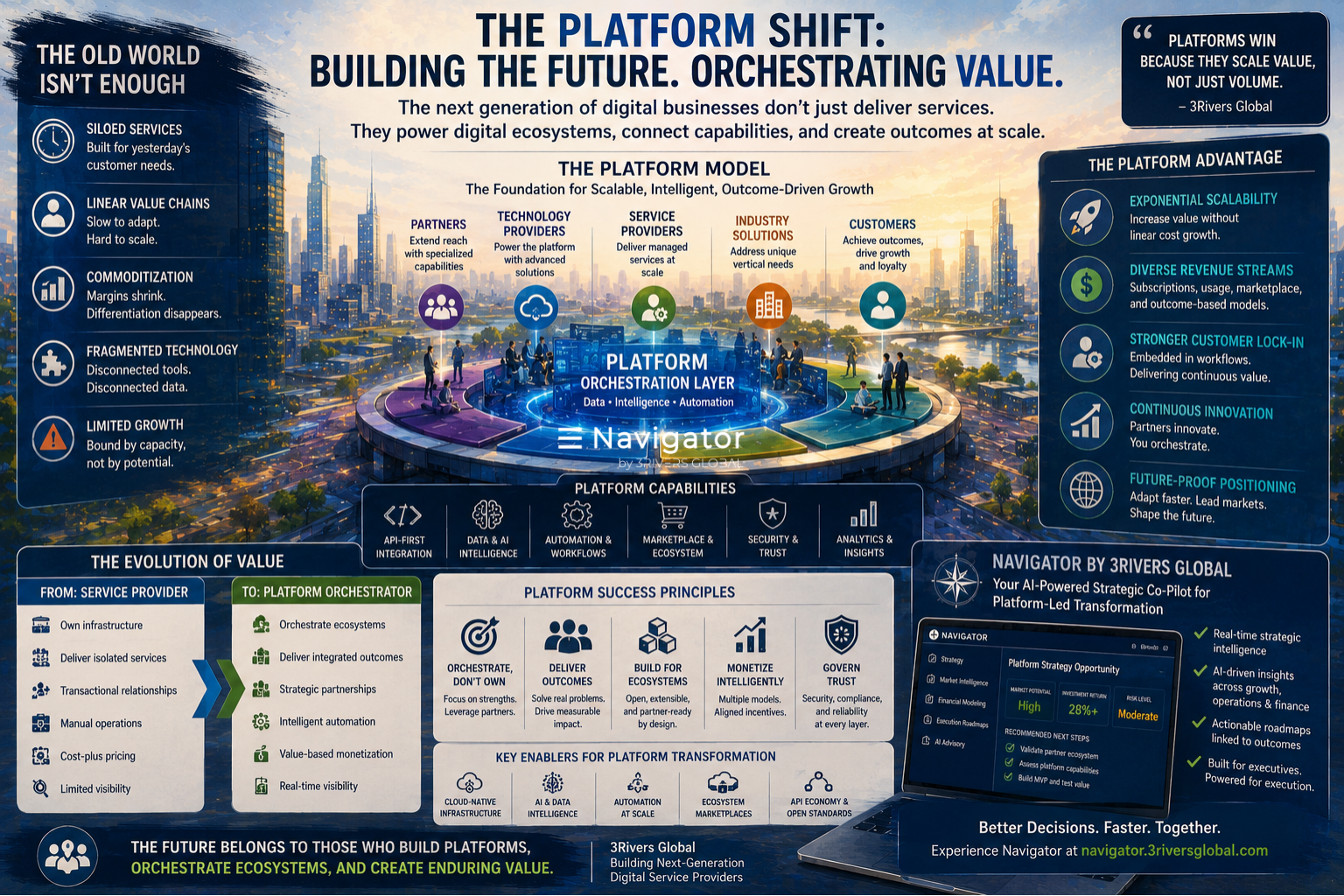
The Next Competitive Advantage Isn’t What You Sell—It’s What You Enable
For decades, businesses competed by offering products. Then they competed by offering services. Today, a new reality is emerging across industries:
The highest-performing organizations are no longer simply selling products or delivering services—they are building platforms.
This shift is changing the rules of competition.
Whether you are a technology company, a managed service provider, a professional services firm, a manufacturer, a financial institution, or a growing small business, the future belongs to organizations that can create systems that continuously deliver value at scale.
The question is no longer:
“What services do we provide?”
The more important question is:
“What platform are we building?”
The End of the Traditional Service Model
Traditional service businesses have fueled economic growth for generations.
Consultants provide advice.
Agencies deliver campaigns.
IT providers manage infrastructure.
Law firms offer legal expertise.
Accounting firms provide financial guidance.
These businesses create value, but they also share a common challenge:
Growth is often tied directly to people.
More clients usually require:
- More staff
- More managers
- More operational complexity
- More overhead
Revenue grows, but costs often grow alongside it.
This model creates a natural ceiling.
At some point, scaling becomes difficult because the business remains dependent on human effort.
This challenge is becoming increasingly visible in a world where customers expect:
- Faster responses
- 24/7 availability
- Continuous improvement
- Personalized experiences
- Lower costs
Traditional service delivery alone cannot always keep pace with these expectations.
The Rise of Platform Thinking
Platforms operate differently.
Rather than delivering value one engagement at a time, platforms create systems that enable value creation repeatedly, predictably, and at scale.
Some of the world’s most influential organizations illustrate this model.
Amazon is not simply a retailer.
It is a platform connecting buyers, sellers, logistics providers, developers, advertisers, and enterprises.
Uber is not merely a transportation company.
It is a platform connecting riders, drivers, merchants, and service providers.
Salesforce is not just a software vendor.
It is a platform that enables an entire ecosystem of customers, developers, consultants, and partners.
The value of these organizations comes not only from what they do directly but from the ecosystems they enable.
That distinction matters.
Why Platforms Scale Faster Than Services
Platform-driven organizations benefit from several structural advantages.
1. Automation Creates Leverage
Platforms automate activities that would otherwise require manual intervention.
Customer onboarding, support, reporting, analytics, workflows, and transactions can all be automated.
This allows organizations to serve significantly more customers without proportionally increasing operational costs.
2. Data Improves Outcomes
Every interaction generates valuable information.
Platforms continuously collect and analyze data to improve customer experiences, optimize operations, identify opportunities, and drive innovation.
The result is a self-improving system.
3. Ecosystems Expand Value
Platform leaders rarely try to do everything themselves.
Instead, they build ecosystems that allow partners, suppliers, developers, consultants, and specialists to contribute value.
The platform becomes the center of gravity around which an ecosystem grows.
4. Recurring Revenue Becomes Easier
Platforms naturally support subscription and consumption-based business models.
Instead of relying solely on one-time projects or transactions, organizations can create recurring revenue streams that are more predictable and scalable.
The Platform Economy Is Expanding Everywhere
Many business leaders still associate platforms exclusively with technology companies.
That assumption is becoming increasingly outdated.
Today, platform models are emerging across nearly every sector.
Professional Services
Consulting firms are creating digital advisory platforms.
Healthcare
Healthcare providers are building integrated patient engagement ecosystems.
Financial Services
Banks are becoming financial platforms that connect multiple products, services, and partners.
Manufacturing
Manufacturers are creating connected ecosystems around equipment, analytics, maintenance, and supply chains.
Managed Services
Managed service providers are evolving from labor-intensive service organizations into platform-enabled businesses that automate delivery, monitoring, optimization, and customer engagement.
The direction is clear:
Organizations that embrace platforms are positioning themselves for the next era of growth.
The New Leadership Challenge
The platform shift is not primarily a technology challenge.
It is a leadership challenge.
Many transformation efforts begin with technology selection.
Leaders ask:
- Which AI platform should we buy?
- Which CRM should we implement?
- Which cloud provider should we use?
These are important questions.
But they are not the first questions.
The better questions are:
- What outcomes are we trying to achieve?
- What system are we trying to create?
- How will we generate value repeatedly and at scale?
- What ecosystem should we build around our customers?
Technology should enable the platform strategy—not define it.
From Digital Transformation to Platform Transformation
Many organizations have spent the past decade pursuing digital transformation.
Some succeeded.
Others simply digitized existing inefficiencies.
The next wave is platform transformation.
This means moving beyond isolated technology projects and redesigning how value is created, delivered, monetized, and scaled.
Platform transformation typically includes:
- Automation-first operating models
- Data-driven decision making
- Ecosystem partnerships
- Subscription and recurring revenue strategies
- AI-enabled customer experiences
- Scalable digital infrastructure
Organizations that successfully make this transition often discover that growth becomes less dependent on adding people and more dependent on strengthening systems.
Why Navigator Was Built
This reality was one of the driving forces behind the creation of Navigator by 3Rivers Global.
Over years of working with business leaders, managed service providers, telecommunications operators, technology firms, entrepreneurs, and transformation teams, a recurring challenge became apparent:
Most organizations do not lack information.
They lack a system that helps them convert strategy into execution.
They need a platform that can:
- Accelerate planning
- Improve decision-making
- Surface insights quickly
- Reduce execution friction
- Help leaders move from ideas to outcomes
Navigator was built to support exactly that journey.
Not as another repository of information.
Not as another productivity tool.
But as a platform designed to help leaders navigate complexity, evaluate opportunities, align priorities, and execute transformation more effectively.
In many ways, Navigator reflects the very shift described in this article:
Moving from one-time advice toward a scalable platform that continuously enables better decisions.
The Organizations That Will Win
The next generation of market leaders will not necessarily be the largest organizations.
They will be the organizations that build the strongest systems.
They will understand that value creation increasingly comes from:
- Platforms rather than projects
- Ecosystems rather than silos
- Intelligence rather than information
- Outcomes rather than activity
The future belongs to businesses that can create leverage through platforms.
Because in a world of accelerating complexity, services alone are no longer enough.
The organizations that learn to build systems, orchestrate ecosystems, and enable continuous value creation will define the next chapter of the digital economy.
Building the Future, One Platform at a Time
Every organization faces a choice.
Continue operating primarily as a service provider.
Or evolve into a platform-enabled business capable of scaling expertise, intelligence, and value far beyond traditional limits.
The platform shift is already underway.
The only remaining question is whether your organization will participate in it—or lead it.
Leave a Reply
You must be logged in to post a comment.