
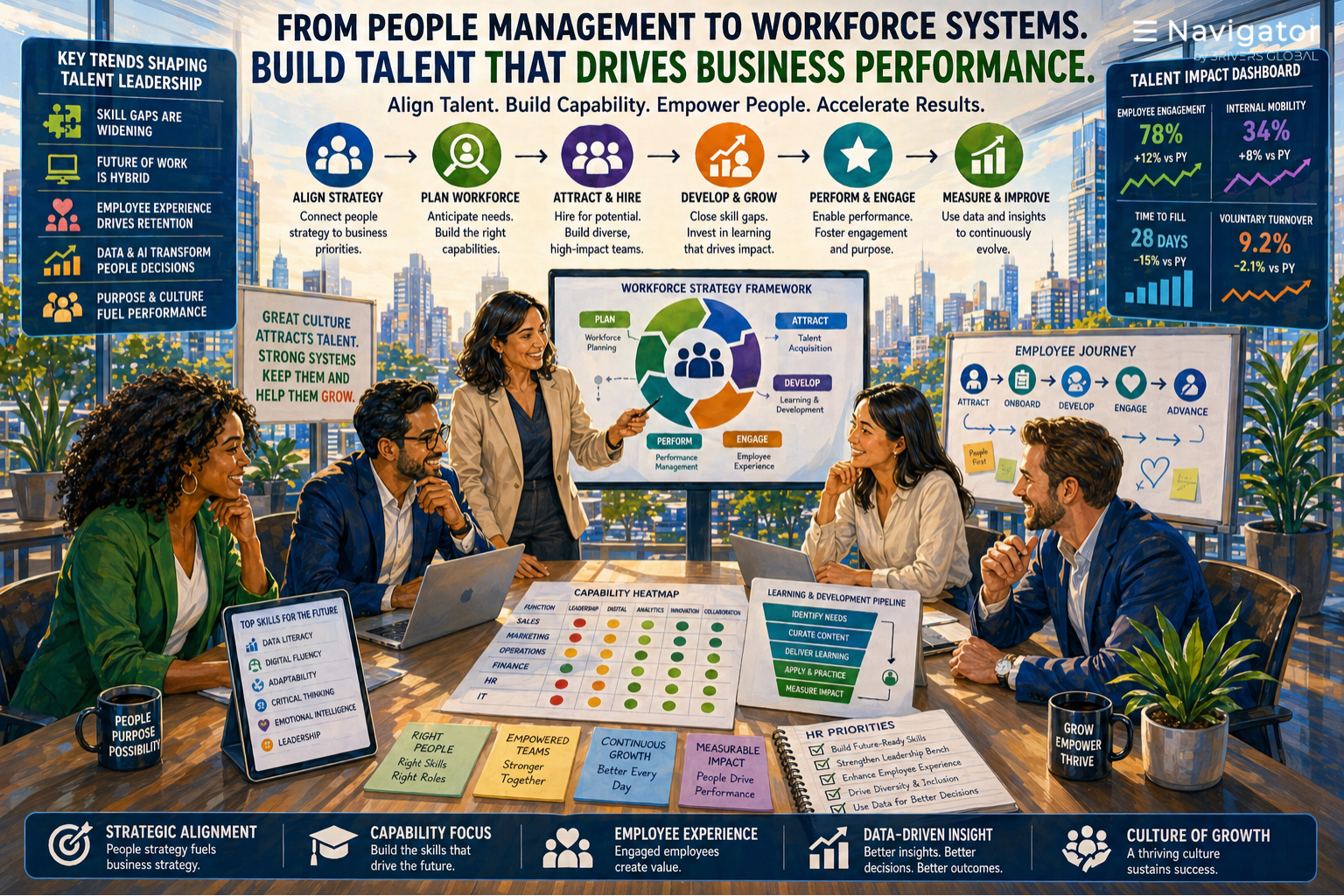
Talent Has Always Been Critical—Now It’s the Differentiator
Organizations have always depended on people to execute strategy.
But today, the role of talent has fundamentally evolved.
HR and talent leaders are no longer just responsible for:
- Hiring
- Compliance
- Employee engagement
They are now central to:
- Driving business performance
- Enabling transformation
- Building future-ready organizations
The challenge is no longer just managing people.
It is designing a workforce system that consistently delivers performance, adaptability, and growth.
The Core Constraint: Talent Without Systemization
Most organizations recognize the importance of talent.
Yet they struggle with:
- Inconsistent hiring outcomes
- Skill gaps that slow execution
- Employee disengagement
- Difficulty adapting to new ways of working
Why?
Because talent is often managed through processes—not systems.
The result:
Strong individuals—but inconsistent organizational performance.
Why Many Talent Strategies Fall Short
Even well-intentioned HR strategies often fail due to:
1. Disconnected Talent Processes
Recruitment, development, and performance management operate independently.
2. Skills Misalignment
Workforce capabilities do not evolve in step with business needs.
3. Reactive Workforce Planning
Hiring decisions are made based on immediate needs—not long-term strategy.
4. Limited Visibility Into Talent Performance
Data exists—but does not clearly inform decisions.
The result:
Effort is high—but impact is uneven and difficult to scale.
What High-Performing HR Leaders Do Differently
The most effective HR and talent leaders don’t just manage people.
They design workforce systems.
They focus on:
- Aligning talent strategy with business strategy
- Building scalable capability frameworks
- Enabling continuous workforce adaptation
They move from:
Managing employees
to
Orchestrating a system that drives organizational performance
This is where platforms like Navigator by 3Rivers Global become a force multiplier.
How Navigator Comes Into Play in HR & Talent Leadership
Navigator acts as a talent intelligence and execution layer, enabling HR leaders to align workforce strategy with business outcomes.
It connects:
Strategy → Skills → Talent → Performance → Growth
Here’s how it directly supports key use cases:
1. Workforce Planning & Strategy (From Headcount to Capability)
Traditional planning focuses on numbers.
Navigator enables:
- Identification of required capabilities
- Alignment of workforce with strategic priorities
- Planning for future skill needs
What changes:
From headcount planning → capability-driven workforce strategy
2. Talent Acquisition Optimization (From Hiring to Fit)
Hiring often prioritizes speed over alignment.
Navigator helps:
- Define role requirements based on outcomes
- Align hiring with strategic goals
- Identify high-impact talent profiles
What changes:
From filling roles → building high-impact teams
3. Skills Development & Upskilling (From Training to Transformation)
Training programs are often generic and disconnected.
Navigator enables:
- Identification of critical skill gaps
- Alignment of learning with business needs
- Structuring of targeted upskilling initiatives
What changes:
From generic training → strategic capability building
4. Performance Management (From Evaluation to Enablement)
Performance reviews often focus on past performance.
Navigator helps:
- Align performance metrics with business outcomes
- Identify drivers of high performance
- Enable continuous feedback loops
What changes:
From periodic evaluation → continuous performance enablement
5. Culture & Engagement Strategy (From Initiative to System)
Culture is often treated as an abstract concept.
Navigator enables:
- Identification of drivers of engagement
- Alignment of culture with organizational goals
- Structuring of scalable engagement strategies
What changes:
From isolated initiatives → intentional culture design
The Real Shift: From HR Function to Workforce System
Traditional HR operates as a support function.
Modern HR operates as a strategic system.
| Traditional HR | Evolving HR |
|---|---|
| Process-driven | System-driven |
| Hiring-focused | Capability-focused |
| Reactive planning | Strategic workforce design |
| Engagement initiatives | Culture systems |
Navigator enables this shift by ensuring:
- Talent aligns with strategy
- Skills evolve with business needs
- Performance drives outcomes
Why This Matters Now
HR and talent leaders face increasing pressure:
- Build future-ready workforces
- Enable digital and business transformation
- Improve employee experience and performance
At the same time, the opportunity to create impact has never been greater.
The difference lies in:
How effectively leaders can turn talent into a system—not just a function.
Final Thought
Organizations do not succeed because they have talented people.
They succeed because they have systems that enable those people to perform at their best.
Because in today’s environment, success is not defined by:
The quality of individual talent
but by:
How effectively that talent is aligned, developed, and deployed
And the defining question becomes:
Are you managing talent—or building a system that turns talent into sustained performance?
Leave a Reply
You must be logged in to post a comment.